Wednesday, September 27, 2006

XML Tage Berlin 2006


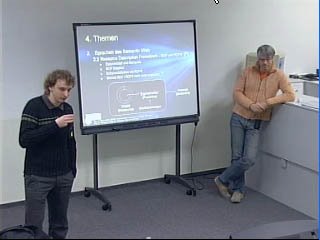
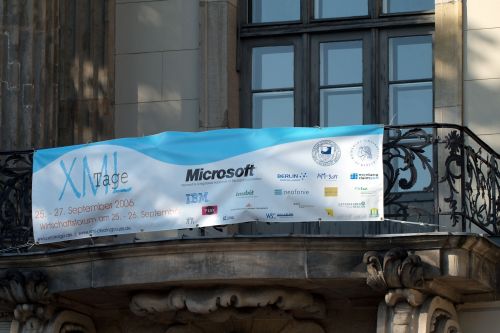
I'm just back from the XML-Tage in Berlin, an annual event dedicated to XML-Technology -- which means a real broad spectrum of topics. For being a mere 'national' event - the conference language was german - a huge number of participants showed up -- at least on the list of participants there are more than 500 entries. But, the lecture room where our sessions took place wasn't crowded at all (30 - 50 people). Interesting for me were the two invited talks: Heiner Stuckenschmitt from Uni Mannheim was asking 'what's wrong with the Semantic Web?', giving way to modular ontologies and distributed reasoning -- thus, for the semantic web we will need some distributed semantic google.... Andreas Hotho from Uni Kassel gave a presentation on bibsonomy, the well known social tagging (bibtex database) service. In the same way as del.icio.us, bibsonomy is tagging urls. But, in addition, you are able to administrate (and tag) your (and others) bibtex bibliographies...a rather useful tool for authoring scientific papers.
If everything works out well, we will cooperate with Andreas and his group by enhancing bibsonomy's features as well as by exploiting bibsonomy's database for Ontology Learning and Data Mining.

Tuesday, September 19, 2006

Web Monday in Jena - Aftermath


Yesterday evening, I visited the first Web Monday in Jena (see yesterday's Blog post). After all, it was a reall success. With almost 50 participants (ok...some 10 or 20 of them coming from synchronity alone) I had a large audience for my presentation on 'Semantic Web 2.0 Hype...'. After Lars welcomed all guests he briefly explained the idea of Web Monday and its relation to web 2.0 in general. Interesting thing to mention is that I became acquainted with Lars via openbc - although his office is only a few minutes from mine. He told me about Web Monday about a month ago and I volunteered to give the very first keynote speech -- although I first thought that I only had to give a 5-10 minutes spotlight talk (as it is the traditional way for Web Mondays).
My talk went rather smoothly but according to the echoes of our audience (see links blog references below) they seemed to like it.
For me the following discussion and socializing was even more interesting. Only to mention a few of the emerging topics:
  • web 2.0 and handicapped users -- a rather interesting and IMHO also important topic (application of specialized CSS, etc...)
  • user generated metadata beyond mere tagging (semantic wikipedia, ontology editors, etc...)
  • semantic web technology vs. information retrieval technology
  • ajax vs. modern programming paradigms and wasting resources (bandwidth)
  • applications of the web of trust
All in all the evening was some real success and we should be curious about the upcoming Web Mondays (ass proposed on October 16th and November 20th). So stay tuned!
Finally some echoes from other blogs:

Monday, September 18, 2006

Web Monday in Jena

Today, the first Web Monday in Jena will take place at TowerByte eG, c/o Intershop Tower, Leutragraben 1, 07743 Jena at 19.30. Lars Zapf volunteered to bring the idea of Web Monday to Jena. Web Monday is kind of an informal meeting focussed on the topic of web 2.0 (in the broadest sense). It connects users, developers, founders, entrepreneurs, venture capitalists, researchers, web pioneers, bloggers, podcasters, designers and other folks interested in Web 2.0 topics. I will host the 'opening session' with a talk about 'Semantic Web / web 2.0 - Hype and Reality'.
The tricky thing for me in this talk is, how to connect semantic web and web 2.0.....and the answer is pretty simple as that. What is needed to bring Semantic Web to life? [short theatric pause] Yes, it's Metadata! And what's the 'dernier crie' concerning web 2.0? [another pause...] Yes, collaborative tagging! So, maybe we should choose collaborative tagging as kind of 'missing link' in between web 2.0 and semantic web.
Of course - you will say - tags are only flat (shallow) metadata without any structure, etc....But why not create structured metadata (or even 'deep' and complex metadata) in a collaborative way. What's missing are - again - suitable interfaces (technology) for easy (non expert) metadata (ontology) editing. In semantic web, somehow we have the same situation as in pre-Blog/pre-Wiki times....only experts are able to create complex metadata... but there are too few of them...and thus, too few metadata. Semantic Wiki is one initiative that points in the right direction. Rico Landefeld is one of my students, who for his diploma thesis tries to implement a fully functional semantic wiki (maariwa). more to come soon....

Monday, September 11, 2006

InetBib 2006 in Münster


On wednesday, September 6th, I visited InetBib 2006 (a conference on libraries and the internet) in Münster. Together with Steffen Büffel and Michael Schaarwächter I was contributing to the workshop Web2.0- Technologien: Zukunft der Bibliothek - Bibliothek der Zukunft ("the future of libraries" and "the library of the future"). From my point of view (as a computer scientist) libraries and Web 2.0 in combination constitute a rather interesting subject. Decentralization of information, active interaction with and involvment of the users, esp. w.r.t. providing keywords and tags for the library index (catalog), blogs and wikis as new (living) web based library information systems are only a few of all those rather promissing approaches. I have collected a few links on articles and further resources about InetBib 2006:

Friday, September 01, 2006

An Integrated View on Document Annotation.... (part 3)

As already mentioned in [1], we identify three semantically interrelated structures within a document or a collection of documents:
  • logical structure (chapters, paragraphs, pages, ...)
  • conceptual structure (index entries, concepts, definitions, ...)
  • referential structure (references, associations, links, ...)

All three in concert form the so called dependency graph (or reading graph).

Now, what is the purpose of this dependency graph? Imagine, your intention is to understand a certain topic. What you usually do is to enter one or more descriptive keywords related to that topic into a search engine. More traditional, you would look up the index of a textbook for those keywords to identify some relevant sections to read to understand the given topic. Probably you look up a certain index entry and the section in the text contains other terms that you don't understand. Thus, you look up those terms in the index to read the referring section and you will probably again find terms that you don't understand. Thus you enter an interative process that stops, if you have read all sections that cover all the terms that you didn't understand before looking up the first index entry.

In this way, we recursively define a rather simple concept of understanding: To understand a term, we have understood all terms that are mentioned in a descriptive definition of that term.

This iterative process is closely related to self containment. Therefore, to understand a topic means to calculate the self containment closure of that topic. The size of the closure is determined by the end of the iterative process. The process ends, if there are no new terms that are not understood (i.e. read). Thus, the size of the closure depends on how much the user already knows (i.e. has read), is different for individual users, and changes (adapts) while the user is reading (understanding).
The dependency (reading) graph is then ordered sequentially (with the help of the logical document structure) to form a roadmap that leads to a better understanding of the given topic.
(to be continued....)


References:
[1] An Integrated View on Document Annotation (part 1) (part 2)

Tuesday, August 15, 2006

flickr!

Quite a lot has been written about flickr. Of course it's a great tool combining a web based picture database and a collaborative tagging system and I do like it. Image processing and tagging, creating groups and social networks...really well done. But, from my point of view, what really sucks is flickr's tag based image search. Here, all the negative stuff that can be argued against the use of collaborative tagging systems (CTS) can be found.

Ok, let's start with the general shortcomings of keyword based search engines:
(1) Homonymy: The keyword used to query the search engine can have multiple meanings while being the same word. This means that you will get many non relevant results (bad precision) because their keyword refers to another meaning.
(2) Synonymy: There are other words that have the same meaning as the keyword that you have entered as query string. Thus, you won't get all relevant results (bad recall). This also refers to the fact that flickr is an international platform and the tags being used are of multilangual origin.

Usually, one can try to cope with this polysemic shortcomings by refining the query string -- broadening or narrowing the search results by connecting additional keywords with a boolean operator (AND / OR).
Then, in CTS there are additional problems that originate from the people's way to generate tags.
(3) Tagging: Different kind of tags can be distinguished. A rough classification distinguish between descritional and functional tags. While descriptional tags -- as the name says -- describe the resource being tagged in a general way ( and thus, might be also useful for others), functional tags most times are only relevant for the single user who tagged this resource.
Classic example: A picture of an apple can be tagged as 'apple' (relevant for all users) as well as 'breakfast' (relevant maybe for a fraction of users).
Taken all three arguments together, collaborative tagging systems really have some problems, if they are considered as search engines, because bad precision and recall lead to bad results.

Another point is relevance. Search engines -- as e.g. google -- introduce relevance weights (as e.g. google's pagerank) to consider the importance of the single search results. The search results are ordered according to their relevance. Google's pagerank roughly reflects the fact that a resource can be considered as being important, if many other resources link to that particular resource (in addition also the number of outgoing links and the weight of each single link is considered). So, try to adapt this concept to flickr.... First, a picture doesn't link to other pictures. No big deal, flickr offers the user to choose 'favourites' among all the pictures. In addition there are some statistical indicators, as e.g. page views or an indicator of 'interestingness' as well as the number of comments. Thus, a relevance indicator could be moulded that could be used for a ranking of search results.

Unfortunately, if you try a search in flickr you will get a huge amount of results without any visible order or relevance. (Simply try 'Rome', you will get more than 290.000 results. Of course there are pictures of the city of Rome among the results...but also many other pictures, where the tag 'Rome' has been assigned for other reasons.)
One problem with flickr for sure is that it is not a 'real' CTS. It seems to be focussed on people tagging their 'own' resources and not the resources of others. In addition, the tags being assigned to a resource are considered as being a set and not a list (or bag - where you can see how often a tag has been assigned by how many users). Thus, tag convergence is out of reach.


On the other hand, there are some nice tools around. Just try this nice little flickr tagbrowser application. OK, it has the already mentioned shortcomings, but it's a nice little gadget.
Friday, August 11, 2006

The Secret Life of Meta Search Engines...

As you probably know, during the last two weeks I had to spent a lot of time in oral examinations about last semester's "web technologies" lecture. Whenever you do examinations, you might get some insight on what the students did understand and what they kept in mind from your lectures. Sometimes you wonder and ask yourself "What the f.... were they doing while sitting in your lecture??" You try to make it simple and give some hints on what is important and what is not. But I guess, sometimes you just make it too simple for them...and thus, they underrate the whole thing and you'll get the receipt during the exam...
Anyway...sometimes the students seem to have some 'cloak-and-dagger' sources of information...as I had to experience last tuesday. I was just starting the exam with a question about search engine types, which finally lead to the (not so important) topic of 'meta search engines'. Usually, I ask how meta search engines are working and try to get quickly to some more interesting topics. On tuesday I received a strange answer ... and the funny thing is that I was told the same queer answer already by another student the week before:
"Meta search engines have their name because they are search engines that analyse the meta-tags in the header of HTML documents..."
Okay...stunned I was looking at my assessor and the assessor immediately stopped writing his protocol also having a stunned expression in his face. "From where did you get that?", I was asking the student. But he explained to me that this fact is just obvious and everybody knows...
Sometimes you really wonder what they are doing while sitting in your lecture...
If a third student will come up with this answer I'll have to cover up the source of this "information".
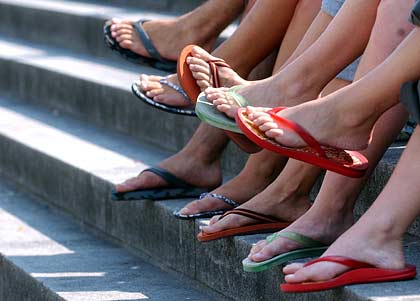
(At least - as we have more friendly temperatures now - they are not wearing muscle-shirts and flip-flops... :-)

Tuesday, August 08, 2006

An Integrated View on Document Annotation.... (part 2)

It is important to state the dependencies between the three identified characteristcs (logical, conceptual, and referential) that are common to any kind of document despite their heterogeneity.

As e.g., let's consider a large text document (textbook). The document's index can be considered to be part of the conceptual document structure, while the linear text flow with its hierarchical structure defines a part of the logical document structure. The index of a textbook can be considered as being of good quality, if an index entry in the first place refers to the location, where the concept denoted by that index entry is defined and subsequently to the other locations, where it is used. Thus, we distinguish between concept definition and concept usage (refering to the logical structure) for the document index (conceptual structure). Obviously, both are dependent on each other. The same holds for the bibliographic references (referential structure) together with the table of contents (logical structure) and the document index.

We claim that these dependencies within a document have to be made explicit. As additional document annotation these dependencies can help to represent document semantics without the necessity to really "understand" the content of the document. Acting in concert with external (user and/or author defined annotations) the document dependency structure is able to facilitate cross annotation reasoning that is a prerequisite for the semantic web.

Thursday, August 03, 2006

An Integrated View on Document Annotation...

Did you realize that documents - no matter what type of document, as e. g., text documents, graphic documents, or videos - can be all subsumed within an abstract view?

We can define a document to be a string of addressable tokens. Some of these tokens are special tokens, the so called tags. In difference to all the other tokens that can be regarded as the document content, tags have a special function: they mark up single tokens or groups of tokens (document units) to be interpreted in a special syntactic or semantic way. On the other hand, tags can also be interpreted as document annotation, i.e. the document can be regarded as an unformatted string of tokens, while the tag (annotation) defines the document structure. We distinguish between different types of tags:
  • structural tags define the structural elements of a document, as e.g., in a text document we can define sentences, paragraphs, sections, chapters, headings, annotations, e.a.
  • referential tags define relationships between document units of the same (internal) or some other (external) document unit, as e.g., in a text document see-references or bibliographic references, e.a.
  • conceptual tags define concepts and relationships of concepts within a document, as e.g., in a text document index entries and hierarchical relationships of index entries, e.a.
Thus, within a document, we can distinguish between the logical structure, the referential structure, and the conceptual structure that are each dependend on each other. Additionally, we distinguish between tags that are supplied by the author (e.g. structural tags) and tags provided by the user (e.g. "tags", annotations, reviews, e.a.).

We can apply this view also on other types of documents, as e.g., video documents: The smallest unit - the tokens - of a video document is a single pixel. Considering the logical structure, pixels can be subsumed to blocks, which form macro blocks, which can be subsumed to slices, which together constitute a frame (picture). In difference to a text document, a video document also depends on time. Thus, we can identify groups of pictures (gop) that form the entire video sequence. In mpeg-4 we even have the possibility to identify objects within a picture that can be subsumed within a scene. With mpeg-7 also conceptual and referential information can be added to the video by adding metadata about the author or about objects or scenes within the video.

Tuesday, August 01, 2006

Men and Flipflops....


Summer seems to take a little break - at least the temperatures are below the 30s - and immediately you start to miss it. Have you noticed that most people don't seem to realize that the temperatures have dropped. They seem to pretend we're still in the tropics...at least considering their style of clothing.
Yesterday I had a student in oral examination wearing only a tight muscle-shirt...you could really see the sweat of anxiety being cooled down by the air condition dripping from his naked skin...I wonder what will be next to be seen, if the temperatures start to rise again. Bare chest, bare foot, or even.....I don't want to imagine?!
But, this reminds me of the "flipflop dilemma". Yes, men in flipflops...not those flipflops made of transistors being basic electronic components. For decades those electronic flipflops were the only flipflops to be associated with the male (geek). Not at all ... I'm talking about those bathing shoes called flipflops. The have their name because of the sound they produce while walking. Yesterday I read a flaming article about men and flipflops in spiegel online. Nice quote: "Shoes that are able to say their name, being worn by men that are not able to spell the word style...". Don't get me wrong. Of course you can wear whatever you like, but please consider the occasion!
During the last weeks really it was rather hot. But the office is air conditioned (you will freeze) and an examination is an examination...and not a seaside holiday pool game.

Friday, July 28, 2006

semester break...


Finally....we've made it. Another semester is over .. well, lat's say is almost over. At least no more lectures this summer. The semester was concluded by a two days seminar on the "Semantic Web".
All seminar talks have been recorded and will be available soon on our website. Well, not really all talks. One student was concerned about having his video being available on the internet so everybody would see him. Thus, his talk - on "Ontology Merging" - which by the way was a rather interesting and very well done talk, unfortunately was only savoured by the participating audience.
We decided to offer a complete lecture on "Semantic Web" in the upcoming winter semester including a lab course. The purpose of course is to attract some potential candidates for semester and diploma theses, because we have a lot of work to do in thal field and thus, various interesting topics to work on.
Well..the semester did not really end now, but there still are the exams (for the web technology lecture)....starting on monday. We have a lot of students from bio-informatics (even more than computer science majors) and I hope they will be well prepared. Hey (listen!)....it's rather simple to be well prepared. Even if you didn't visit all the lectures..yes, they are all recorded and still available on our website. And if you don't have a stable broadband connection to the internet (or don't want to 'waste' your online time) your have the possibility to get all the lectures (including all lecture material and links) on dvd (just write me an email). So...the main topics for the exams will be web caching, web programming (rpc,rmi,corba,j2ee,servlets,jsp,...), search engines, web 2.0, web services, and semantic web.

BTW, last week I attended a rather interesting workshop "Social Software in der Wertschöpfung" (could be translated as "added valued of social software") in Stuttgart. I was giving a talk on "Collaborative Tagging Systems and the Emergence of new Social Networks". Thus, the most interesting talks for me of course have been the other talks about collaborative tagging services and recommender systems. Andreas Hotho from the University of Kassel presented their "bibsonomy" service, an alternative to the well known del.icio.us including a tagged database of bibtex records (what makes it really interesting for researchers and scientists). To attract new users, you can easily import all your local bookmarks as well as your del.icio.us bookmarks. Also you can upload entire bibtex libraries and tag each entry , e.g., with a reference to the papers were it was used as a bibliographic reference or with the name of a specific conference. The nice thing about bibsonomy is - at least as Andreas has anounced it - that its data is supposed to be open source / public domain. This means that after making user names anonymous you can access all tags and resources for testing new methods of ontology learning, doing researched on social networks being induced by tag usage or resource sharing and many more.
The other fortunate coincidence there was meeting a former student from Trier, who is now doing on his PhD and is well known for being a rather ambitious blogger.

Friday, June 30, 2006

Tag Clouds & Word Clouds


Ok, monday's lecture topic will be "Web 2.0" ... and of course we will talk about tagging, folksonomies, and tag clouds (as well as word clouds). A word cloud is a visual depiction of content (words) used in a body of text ... and here's the word cloud for my homepage.
You can create your own word cloud (and design a word cloud t-shirt...)

Thursday, June 29, 2006

time flies...

Only four weeks and the semester will be over ... this means only three lectures to go. This semester the monday lecture included 2 holiday mondays, 1 workshop moday, and....the semester started on a tuesday. This means that instead of 14 lectures I had only 10 (!) ... lucky me....but somehow I had to stuff all the 14 lecture's information into only 10 weeks .. and ofcourse I had to shorten it somehow. We left out eBusiness (more interesting for students of economy), Basic Web Security (should have been already done in basic and networking lectures), and we will probably also leave out Trust Management and the Web of Trust.
I focused on web programming concepts (ranging from rpc to web services, covering web frameworks as well as ajax), search engine technology (how does google work...and how to improve it), web 2.0 (the recent hype...), and semantic web (the next hype...). We have just finished two lectures on search engines and next monday (july 3rd), the topic will be Web 2.0 with all its collaborative tagging, folksonomies, social networks, ajax, xml, etc... It's a entire new lecture (because Web 2.0 as a concept is rather new...remember the term was coined in 2004, although most of its technical infrastructure did already exist before), so I promise it might get quite interesting...

Saturday, June 10, 2006

don't tell me...

Hey....what a week! Ok...it was a rather short week with monday's holiday, but I'll tell you...
I came down with a bad cold starting last sunday. So I was sneezing, caughing, and felt as if I had egg salad in my brains (if there's anything left of it). Then there were those deadlines....the patent application, the XML-Days paper, and several really important meetings. Everything worked fine - I don't know how I managed it - until friday. The most time-consuming thing of all was to get our XML-Days paper ready. I told Heiko (my coauthor) to start to work almost two weeks ago...but I knew in advance, where (better when) it would end....in a night shift on the very last day...friday. The deadline was friday night, 23.59 pm...we were stil working at 23.50pm, when Heiko was downstairs copying the last changes into our cvs-repository. At 23.52pm I received an email. It said......'attention: the deadline is extended to friday, next week!'.....
There I was, 23.53pm...thinking about what I could have done instead this night and all the nights before. I told it to Heiko at 23.58pm - just after printing out the final version for submission ;-)
so, don't tell me....

Thursday, June 01, 2006

web application development...


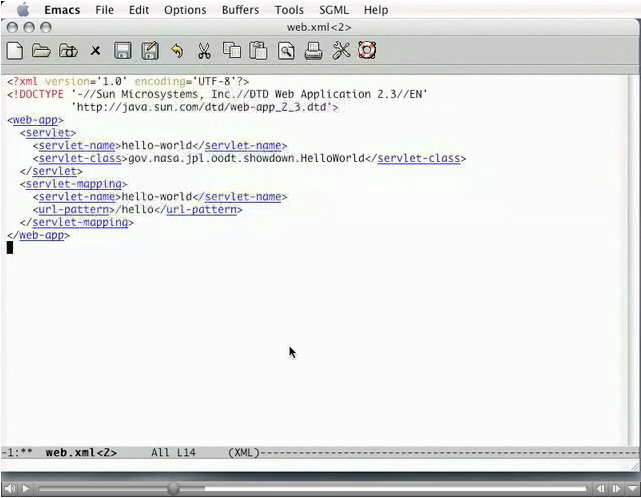
This suits perfectly to the current topic 'web programming' of our lecture 'web technologies' at the FSU Jena. Sean Kelly is giving a very nice presentation on better web application development. Definitely worth while listening, not only if you are one of my students....

Thursday, May 11, 2006

It was only a matter of time...

...that Google launched an own collaborative tagging service. Delicious went to Yahoo, and we were just about discussing plans on exploiting collaborative tagging for improving web search. With Google's personalized search you have the possibility to define and to add taggs to web pages (i.e. the results of your Google search). But, as said before, it was only a matter of time, because it was so obvious to use theese so called folksonomies for improving the results of a web search.
So what about all the other taggers...will they survive?

Thursday, May 04, 2006

Trust in me....I know what I'm doing


According to a recent demographic survey most Americans trust in their government more than in their media. In Germany the situation seems to be similar...only that according to the study Americans think of their government being much more trustworthy than ours...Should I be worried?
Either Germans are much more suspicious than Americans, or our media are much worse. Certainly, we have the 'Bildzeitung' spreading the 'holy truth' day by day...but the one thing I'm concerned about is that almost 43% really seem to trust the media....
BTW, in Germany we trust news coming from friends or family only by 25%. This means that we have more trust in the 'Bildzeitung' than to anyone in our family....strange world. At least we think that Blogs far more reliable (38%) than any family member. Hurray for the 'BILDBlog'!

Wednesday, April 26, 2006

hey...what a crowd (part 2)


On monday I gave my first lecture on webtechologies for this semester. In difference to the semantic web seminar the lecture room really was crowded. I guess there were about 30 students - computer science majors and minors also as bioinformatics. Of course its much more fun if there are a lot of students in the audience...at least if I'm going to pretend that they are there because my lecture is somehow interesting for them. on the other hand, the semester takes 14 weeks....but there will be at most 11 lectures because of holidays and because of the semester was starting at tuesday. I guess, I have to talk even faster than usual :)
But there is also good news for the semantic web seminar. We have 6 students now enlisted for talks and there will be at least 11 talks (including those given by Heiko and myself).

BTW, there has been report on a new way to determine Google's index size. You simply try to find the most popular search keyword and examine the number of page hits. For the english article 'a' there are almost 25 billion hits....this means that there are 25 billion pages in Google's index containing the word 'a' (which includes at least every english web document).

Friday, April 21, 2006

Finally, I have an URI...

I've just read about in Tim Berners-Lee's Blog and so I have an URI now. It just refers to personal information about myself listed in my FOAF file. My URI is now

http://www.informatik.uni-jena.de/~sack/foaf.rdf#HS

As proposed in the referred article, everybody should have one...at least if you want to become part of the semantic web.

Tuesday, April 18, 2006

hey...what a crowd


Summer semester started today...right at 8 a.m. with the Semantic Web seminar. And what should I tell ya...what a crowd...I was looking into the more or less sleepy faces of three students. Shouldn't you think, the semantic web isn't something interesting??
I wonder, where all the computer science students do their seminars.....databases, I guess. It's so much more related to "practical" work and yes, it's so interesting to find the 27th normal form in fuzzy object quadrupels...not to mention that, if you really choose to become a database "expert", you will spend your entire life creating, maintaining, and programming databases of a certain (within here never to be mentioned) distributor (...a three letter word...pssst). Life could be so exciting....
O.K....there's always something good about bad things...at least I don't have to get up too early this semester. We will do the seminar "en block" at the end of the semester. Have a nice life :)

Thursday, April 13, 2006

and again ... a new semester starts next week


Next week, on April 18th , the summer semester starts....and for me it starts right at 8 a.m.
For years now, I'm struggling with those 8. a.m. lectures...I have always bad luck. Every year, again and again, they give me the 8 a.m. lectures...
O.k....in summer it's not as bad. At least the sun is already up in the sky (if it's not overcasted, and rainy....as it is many times), and you avoid the "sleepy" summer afternoons. But, you know the students....who wants to get up so early, who isn't sleepy that time of day (at least I am...). This year I boldly arranged my "Webtechnology" lecture on mondays 10 a.m. ... but I didn't realized that they have scheduled my seminar "Semantic Web" on thuesday/thursdays at 8 a.m....
O.k....for two days in the week get up early, no chance for sports before work (only if I want to get up at 5 a.m.)...and of course looking into the face of sleepy students.....
Oh...wait! It's a seminar....this means that most times the students have to give the talking and I'm the one who listens. But - even worse - I have to listen carefully to give a sound critic afterwards...

So, everybody who wants to sleep longer (and who is able to understand german) might watch my lectures/seminars on the web. Unfortunately - at least up to now - I can't give them from home. Just imagine....get up at 7.45 a.m., brush teeth, get a cup of coffee, arrange yourself in front of your webcam, and give the lecture.....

Thursday, April 06, 2006

Retreat "E-Teacher" in Dornburg


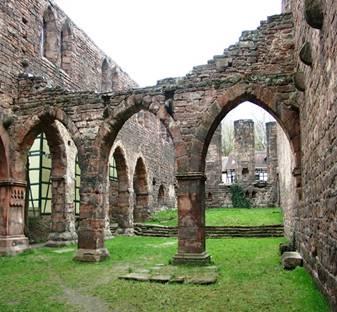
April 3-4th, I visited a retreat at the "Altes Schloß Dornburg" (old palace Dornburg) about a project called "E-Teacher". The medieval palace is located high above the river Saale with a beautiful view over the Saale valley. Rather interesting to watch because of the current spring flooding...
The E-Teacher project is about feedback based learning. I know...E-Learning is anything else but new. But the only feedback provided to regular E-Learning software nowadays are multiple choice tests etc...The E-Teacher system is supposed to watch the student closely. Facial Action Codes (FACS) are translated into emotions, giving advice about how to proceed within the learning scenario. In doing so, the system needs representations for the knowledge to be taught, for the student (how does she feel...), and for various didactic strategies.
The chosen topic to teach are NP-complete probems (btw one of the millenium price problems). I was giving a talk about NPBibSearch, a bibliographic search engine focused on papers related to NP-complete problems....and of course based on an ontology representing knowledge about NP-complete problems.

Thursday, February 23, 2006

Internet and Civil Law


This week I had to give a lecture on Internet basics at the symposium "Internet and Civil Law" at the German "Richterakademie" (which is a conference center esp. for judges) in Trier. I lived in Trier when doing my PhD before I went to the University of Jena. It's interesting to get back to a town where you have lived for a long time. Everything seems to be rather familiar....but it isn't anymore. Things are changing.
So does my internet (basics) lecture. Although this symposium takes place every other year, almost 50% of my lecture differs from the lecture given the last time. The internet (and the Web) is rapidly changing....

Friday, February 17, 2006

"Informatik der digitalen Medien" Wintersemester 2005/2006

Another semester is over now. Again I had an interesting class for my lecture "Informatik der digitalen Medien" with students of 'lectureship' (=Lehramt), i.e. students who want to become a teacher, coming from a variety of fields of study.
Working with students of computer science is always (...better say most times) easy, because (at least you should assume) they all have the same background. Here, it was completely different. The fields of study of the students was ranging from german and geography, over sports and other languages, up to mathematics and computer science. All in all, really a great variety...and we had a lot of work to do: only 14 lectures and the material was ranging from computer network basics, coding theory, data compression, up to web technologies.
I like these lectures, simply because they teach you (i.e. me as a lecturer) to look at the stuff of your daily work from a completely different point of view. You have to explain things in a way that also non computer scientists (with almost no mathematical background) will understand....and that's a tough job, sometimes.
The lectures are recorded on video and available at its web page.
..hmm... I guess, I'm planning to put this special lecture down in a book....

Tuesday, January 10, 2006

anni squared


anni squared
Originally uploaded by lysander07.
ok....besides semantic I do photography. With flickr there is a great platform for sharing pictures of any kind...and it offers the posibility to post your pictures in any of your blogs. So, this will be my first one.

Thursday, December 15, 2005

SWAP 2005 - aftermath

SWAP 2005
Semantic Web Applications and Perspectives '
2nd Italian Semantic Web Workshop
Trento, Faculty of Economics
14-15-16 December, 2005

I really enjoyed being there in Trento. The topics were mainly on ontology engineering and I was presenting a paper on NP-BibSearch, an ontology based bibliographic Search engine focussed on research papers related to NP-complete problems (here's a link to "NPBibSearch: An Ontology Augmented Bibliographic Search")

Wednesday, October 12, 2005

Pandora's jack-in-the-box


According to greek mythology, Zeus ordered the other gods to create Pandora as a poisoned gift for man. The intention was to punish Prometheus and mankind for betraying the secret of making fire. Prometheus was chained at a rock in the Kaukasus etc... while Pandora was sent to earth. Epimetheus (the brother of Prometheus) fell in love with her, but was told never to open the box, which was given her as a dowry. Until then, mankind had lived a life in a paradise without worry. Epimetheus told Pandora never to open the box she had received from Zeus. However, one day, Pandora's curiosity got the better of her and she opened it, releasing all the misfortunes of mankind. Once opened, she shut it in time to keep one thing in the box: hope...

As a derivative of the Music Genome Project an new music discovery service called Pandora started this week. You enter your favourite songs or artists and Pandora will make suggestions what to listen to. Furthermore, you can tell Pandora if you like its suggestions or not. You can create your own music radio stations and share it with friends. Also, Pandora tells you why it has selected a song it suggests.
Of course Pandora is not created on pure philantropy. The first ten hours of listening are free...and after you have become addicted you have the possibility to subscribe. Personally, I like the general idea of creating your own music radio station to listen to, but the question is, am I willing to pay for it? I don't know..... but I would like to have all the meta data :-)

Friday, October 07, 2005

Self Organized Retreat...


"Self Organization of Computing and Information Systems" was the topic of yesterdays meeting at Stadtroda (about 20 km east of Jena). The faculties of computer science at the FSU Jena discussed the new focal point of research: "Self-Organization".... and of course we have organised ourselves...

Much of our enthusiasm and of our effort went into the discussion about the definition of the term "Self-Organization", but the result was not really satisfying...Take 4 computer scientists and give them a topic to define...and you will end up in at least 5 different disjoint definitions. So what does the term mean...at least to me?
I would agree to the following (minimal) definition:
  • a self-organized system is organizing itself with its own resources with no help or influence from outside
  • self-organizing systems are adapting themselves over the time to fulfill required necessities/ to survive / to achieve a given goal
  • as viewed from outside, self-organizing system indepently develop emerging (higher order) properties that were not previously given within the system layout
ok.... next thing to do is to think of how can I connect semantic web with self-organization...?
Autonomous agents independently fulfilling (higher order) tasks while adapting themselves using semantic description of their environment / using semantics to combine independent and unconnected services / ...

Wednesday, October 05, 2005

"in dubio pro google..."


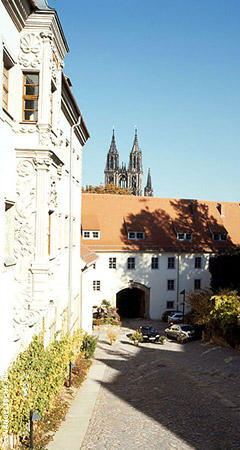
On Monday I had to give talk at the symposium "New Media and Civil Law" for judges in Meißen (Saxony) about internet technology and its economic background. Meißen is well known for having the first european porcelain-factory, the Staatliche Porzellan-Manufaktur Meißen, which is still existing today. The city has a beautifully preserved mediaeval and renaissance historic city center, a gothic cathedral (you can see its twin towers on the left) and with lots of little shops selling antiquities (esp. porcelain of course) and other oddities.

One interesting thing that I've learned at the symposium was that google and wikipedia already seem to be a firm part in the process of jurisdiction and legal practice...someday, highly paid experts and referees - as they are necessary today - might be looking for a new job...
Weird vision...winning or loosing a law suit because of some results achieved by a search engine (lucky for those, having a top page-rank)...google is more powerful than I imagined...

Tuesday, September 27, 2005

....more light!


1832...to be precisely, March, 22. 1832.
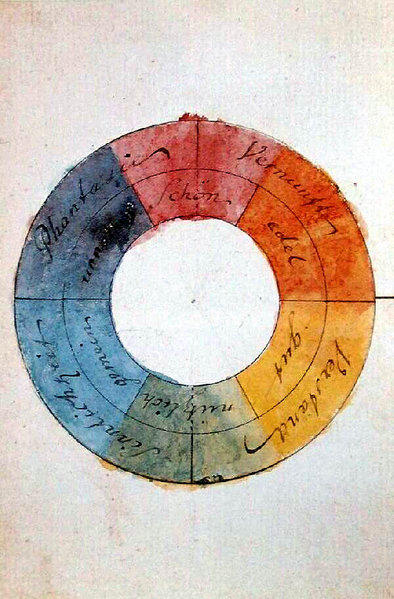
In Weimar (Germany, dukedom of Saxony-Weimar-Eisenach), Johann Wolfgang von Goethe, writer, poet, savant, philosopher, humanist, and statesman, faces his last hours here on earth. When finaly taking his last breath, as legend has it, after an incredibly productive span of life he speakes the famous last words: "..... more light!" ("...mehr Licht!"<- in german). For more than a century scientists were debating about the meaning of these words (..or if they have been spoken at all). Did Goethe want to have the window shutters opened to have more light in the room..... or was he referring to some more philosophical topic in a metaphoric way, meaning to bring more light into the darkness of his (or better our collective) wisdom. Some are even joking that - as Goethe was hessian by birth - he started to say some sentence in hessian dialect, meaning as much as "one is lying in a very uncomfortable way here" ("Mer licht hier so schlecht"<-in hessian).

Ambiguity is a property of human language. Together with a lack of reference, sometimes it is impossible to derive (or even to guess) the meaning of words. One of the topics I'm dealing with ist semantic annotation of information. The transition from the world wide web of today to the semantic web of the near future will be one of the most important steps in technology....maybe with unimagined effects and unforseen side-effects. Therefore, the name of this Blog was chosen .... to bring "more light" into the information universe of the www.

....and of course to talk about life, the universe, and everything that matters....