Showing posts with label social web. Show all posts

Wednesday, June 04, 2008

Semantic Web Podcast Interview

Gestern wurde ich von meinem guten alten Bekannten und Kollegen Steffen Büffel im Rahmen des 3. Dresdner Future Forums zum Thema Semantic Web interviewt. Ich war zugegebenermaßen ein wenig unvorbereitet und via skype geführte Interviews klingen immer etwas hölzern (eher blechern...), aber immerhin, hier ist es nun, mein erstes Podcast-Interview....und natürlich meinen besten Dank an Steffen.


[Link zum Original-Artikel in media-ocean]

Friday, September 28, 2007

CSSW 2007 - Conf. on Social Semantic Web in Leipzig - Aftermath

Back again -- this time in Jena -- I have a few minutes left to draw some resume about the last to days at CSSW 2007.

But first, I have to continue, where I left the day before. The final event yesterday (before the conference diner) was a panel discussion on the topic 'Is there a Social Semantic Web?' with Kingsley Idehen, Marc Fleischmann, KJlaus-Peter Fähnrich, Matthias Bärwolf, and myself. First at all, we did not provide any valid answer to the overall question. In the end, we were discussing, why the Semantic Web does not get the right attention, about (working) business models in Social Web and Social Semantic Web, and about incentives for participation (as well as on open source and open data)....

Finally, I really enjoyed this conference (esp. if you consider my bad experiences with the two conferences last week). O.k., maybe this was because the conference's topic was closer to my core interests compared to e-Learning (DeLFI) or XML (XML-Tage Berlin). There were also much more interesting people to meet, esp. I'm looking forward to meet again a collegue at Potsdam (Universität Potsdam, not HPI). I think, the basic question (as mentioned before) 'Is there a Social Semantic Web?' can be answered with YES. Why?...simply because many Social Semantic Web applications have been resented in the last two days, ranging from Semantic Wikis (where semantic data is authored in a collaborative way), over social networking applications that make use of implicit (semantic) data (and vice versa). I also guess that the topic will become even more important in the very next years. One major point (or objection) was the question about a (working) business model and the incentives being necessary to convince people to participate. It's rather difficult to predict the people's attitude and behaviour. Of course, maybe it's just 'ease of use'. Wikipedia is successful, because everybody can participate with only small effort (he/she must only be able to speak the Wiki-Language). Given that most people have some extraverted tendencies, given the user community of an aplication is of sufficient size, social reputation is an important incentive fr participation. But first, you need to have a sufficient large user community to attract users. Thus, it's similar to the chicken-and-egg problem....
Nevertheless, I hope this tpoic will also be present at this year's IWLS in Korea....

Thursday, September 27, 2007

CSSW 2007 - Conf. on Social Semantic Web in Leipzig, Sep. 27th 2007 - Day 02

The second day of the Social Semantic Web Conference (CSSW 2007 here in Leipzig. Fortunately, Weimar has a rather good train connection to Leipzig (approx. 55 minutes...). Thus, I can sleep at home and don't have to stay in a hotel in Leipzig (and ofcourse the costs for travelling will be reduced...as we have a very low budget at the University for conference travells). Ok, first thing I had to learn was, the conference catering isn't really as bad as I had written yesterday. Actually, you get 5 tickets for refreshments every day (not for the whole conference). Thus, you won't die of thirst ;-)
(the Picture above is showing the University of Leipzig, Jahn Campus, where CSSW 2007 together with SABRE07 takes place)

But, back to the conference program. Today, I will chair the first session and therefore, I'm not able to blog live (at least during the morning). But I will write about the talks as soon as I find some spare time. The following talks are scheduled: Patrick Maué from the University of Münster with the topic 'Collaborative Metadata for Geographic Information'. Patrick is addressing so called participatory Geographic Information Systems (GIS) that are used for decision making, as e.g. in urban planning. Usually this data is published as a catalogue on the web. But, queries to this catalogue suffer of very bad recall and precision. This also comes from the dicersity of people involved in the process of generating metadata. People have different perspective, mental models, and terminology. Thus, the general problem being addressed is refinement of shared metadata. Of the three diffeent levels of semantics ( implicit semantics whic means data gathered from statistical analysis of the original data, soft semantics such as e.g. folksonomies, and formal semantics that allow proper reasoning), Patrick addresses the gap between implicit and soft semantics, and tries to bridge this gap by detecting similarities of metadata.

The following talk by Thomas Riechert has the title'Mapping Cognitive Models to Social Spaces - Lightweight Collaborative Development of Project Ontologies'. There, an application of the SoftWiki ontology for requirement analysis (SWORE) in the software development process is presented. Software development is carried out collaboratively by the different stakeholders of the process with the goal to model an application on an abstract level from different points of view. Stakeholders formulate their requirements in natural language and use the SoftWiki for coordination and aggregation of the requirement model, the project model, and the bug model. Then, stakeholders tag the requirements and from the tags the system extracts relationships between requirements that finally end up in the project model (=project ontology). The content of the three models serves as input to the Software Development process (a.k.a. CASE-Tool), which maps the models to UML and in this way creates the input data for the software developers.

Sören Auer (also co-chair of the conference) concludes the session with a talk on'DBpedia Relationship Finder'. Firt at al, DBpedia is an interesting project that makes use of the (inherent) structured data in wikipedia. This structured data can be found in so called 'info-boxes', i.e. tables usually put in a columns right of the wikipedia article containing data in a well structured (and hopefully commonly agreed) format. This data can be extracted from the wikipedia dump. The structured data is transformed into RDF-Triples that constitute a huge graph. The goal of DBpedia is (in the end) to enable the user to ask complex queries on the structured wikipedia data. The general problem anyway is to visualize this huge amount of data in an efficient way. The relationship finder tries to draw connections between two terms in DBpedia and therefore traverses the DBpedia graph trying to find paths (via different properties being specified by extracted content the original wikipedia info-boxes). These paths are presented in shortest path first order. Up to now, no ranking of paths with similar length is performed. Interesting thing to mention ist that the terms 'Leipzig' and 'Semantic Web' are connected via the property of Leipzig being the city, where Johann Sebastian Bach died ;-)
To get more information, you can exclude certain properties from the result paths (i.d. then only paths, which don't include that specific property are included).

The upcoming session is focusses on presentations around the SoftWiki project (as also was the talk of Thomas Riechert in the first session). The following talks are scheduled: Kim Lauenroth is presenting 'A Processmodel for Wiki-based Requirements Engineering Supported by Semantic Web Technologies', followed by Haiko Cyriaks with 'Supporting Requirements Elicitation by Semantic Preprocessing of Document Collections', followed by Steffen Lohmann with 'Ways of Participation and Development of Shared Understanding in Distributed Requirements Engineering', and Thomas Riechert with 'Towards Semantic Based Requirements Engineering'.

The Session after the lunch break starts with Stefan Kröger from the University of Potsdam with 'Analysing Wiki-based Networks with SONIVIS. The main goal of the Project SONIVIS is (or at least one of the goals...) the Unterstanding of Emergence of Knowledge in Social Knowledge Spaces. As a tool, SONIVIS integrates analysis, evaluation, visualization, and data handling of wiki-based networks.
Rainer Hammwöhner from the University of Regensburg is next talking about 'Semantic Wikipedia -- Checking the Premisses'. For this reason, they took samples from (different multilingual versions of) wikipedia and tested, as e.g., if the wikipedia category system really is a sound taxonomy (...I would say 'no'!). As we already have thought, the category system makes inadequate use of hierarchies, and that the quality of different language versions varies. There seems to be a high amount of disagreement in the category systems of the different language versions.
Joshua Bacher from the Max Planck Institute for Evolutionary Anthropology is giving a Demo Talk on 'BoWiki' - a collaborative editor for biomedical ontologies, gene functions and annotations (originally derived from Semantic MediaWiki, but for being able to use reasoning SMW was given up).
The next demo is given by Marc Fleischmann entitled sMeet-Let's Meet real, a web platform to talk and to sozialice (in an synchronous way) just as in real life. sMeet constitutes a 3D Avatar based virtual community (just as 2nd Live), but connects the virtual world with the phone system....(really an entertaining presentation, I even saw my very first live iPhone...But, I`m missing semantics....). The phone system enables real mobility (a kind of ambient 2nd Live....and the phone system is also something that people are used to pay for) and with sMeet several heterogeneous communities are (at least planned) to be connected.
Richard Cyganiak closes the session with a presentation on 'DBpedia - a Nucleus for a Web of Open Data' providing more background information on the DBpedia project. In DBpedia, every item has an own URI. Simply take the wikipedia URI of an article and substitute 'www.wikipedia.org/wiki' by 'www.dbpedia.org/resource' (here you might find the DBpedia resource named 'Leipzig'). Thus, DBpedia becomes a repository for Semantic Web identifiers.

The final event of today (before the conference diner) was a panel discussion on the topic 'Is there a Social Semantic Web?', in which I took part (therefore no live-blogging). I will refer to that in my next post....

Wednesday, September 26, 2007

CSSW 2007 - Conf. on Social Semantic Web in Leipzig - Sep 26th, 2007

For the next two days I'm going to participate at the CSSW 2007 (Conference on Social Semantic Web) in Leipzig.

The sessions will start at 10am. WLAN is working, live blogging in progress ;-)
Ok, I should not start complaining before it even starts. But, 195 Euros conference fee for 2 days (including allowance for being an 'active' participant) and you have to pay for refreshments in the conference breaks? Ok...we have also received some refreshment tickets...incredibly valuable...representing 5 Euros (of the 195 Euros conference fee)...but one glass of water (or one cup of coffee) is 1 Euro. This makes 5 glasses of water for two days. Anyway.......back to the conference ;-)

After a brief intro by the conference chair Sören Auer, the first talk is presented by Andreas Hees on 'Alternative Searching Services: Seven Theses on the Importance of Social Bookmarking' prommising an interesting combination of traditional search engine indexing and the use of taging. A major difference in both approches lays in the coverage of web pages. While search engines encompass almost up to 85% percent of the 'Surface Web', manual tagging only coveres about a fraction of that. This leads to

  • thesis 1: Limited but Growing Coverage (of Social Bookmarking Services).

  • thesis 2: A smaller index of Social Bookmarking Services does not mean less quality.

  • thesis 3: Less frequent update of Social Bookmarking indexes.

  • thesis 4: The larger the community the more likely users will find specific content

  • thesis 5: SBS are less prone to manipulation (remember the Google vs. BMW case...).

  • thesis 6: SBS are perceived to be more trustworthy than algorithmic search engines

  • thesis 7: Quality of assigned tags will improve


Ok...we all agree on the advantages that SBS do offer. But...how to combine the traditional search engine results with SBS results. This raises issues concerning indexing, actuality, inconsistency, ranking, etc...
The presentation only offers some tag suggestion and tag auto correction mechanisms....so 'how to get better quality tags'. This does not solve the general problem of combining both services.

Rico Landefeld is next, presenting 'Collaborative Web Publishing with a Semantic Wiki', presenting our SemanticWiki implementation Maariwa. One of the questions at the end of the talk concerned the very important topic of the extra 'effort' invested by the author that is necessary for the creation of semantic annotation. The benefit for all the other users is obvious, but for the author himself? Therefore, the extra 'effort' has to be minimized to the limit to make semantic annotation also attractive for the ordinary user.

Mohamed Bishr from the University of Münster concludes the session with 'Weaving Space and Time into the Web of Trust'. What is the influence of spatial dimension on trust? There is evidence of the effects of social network structures on trust as well as of geography on social networking. So the goal is a theory of the dynamics of trust in social networks with respect to the spatio-temporal regularities of the social networks.

The second session is more focused on Semantic Technology. In the first talk, Uldis Bojärs from DERI Galway ist talking about `A Prototype to Explore Content and Context on Social Community Sites`, the SIOC-Explorer ('you may call it RSS on steroids'....as Uldis says). SIOC (pronounces as shok) stands for Semantically Interlinked Online Communities is a W3C submission and is based on an ontology representing the process of social networking on the web (at the SIOC website there is even a wordpress plugin for your blog)....and with the SIOC Explorer SIOC data are crawled and aggregated for browsing and exploring. Furthermore it enables faceted browsing.

The next talk is on 'Adapting an ORDBMS for RDF Storage and Mapping' and is presented by Orri Erling. According to the title a native Relational Database System (Virtuoso) is adapted for RDF. Christian Weiske concludes the session with a talk on 'Implementing SPARQL support for RDBMS and possible enhancments'. To achieve this, a new SPARQL engine was developed and integrated into a database in a way that most of the work load will be accomplished by the database.

So far, so good...Lunch took place nearby in separate room of the Mensa (a review will soon available at küchenschreck and -- the world is small -- I've made some new enjoyable acquaintance, also coming from Potsdam. The afternoon session starts with an invited talk of Hans Hartmann with the topic 'SOA for IT? Hype, Trap, or Hoax?'. First of all, there is a SOA Hype, nobody can deny that. For an illustration, Hartmann compares tha SOA Hype with the excitement of an Austrian radio soccer reporter "....Tor! Tor! Tor! Tor! Tor! - I werd' narrisch! Krankl schießt ein, 3:2 für Österreich" (here you may find the original audio file as mp3).

Next, there is the afternoon's poster (+ demo) session with 5 short presentations. Santtu Toivonen from VTT talks on 'Mobile Social Media - General Characteristics and Interfaces with the Semantic Web'. He starts with a general review on Social Networking Companies and organizes them according to their underlying business models....but in the end, there are no mobile semantic web applications arround.alt least not yet. Next talk on 'Galaxy: IBM Ontological Network Miner' is given by John Judge working at project NEPOMUK (remember the semantic desktop...). I guess I have reviewed this paper...but it has left no remarkable impression so far. Next, Andreas Walter from FZI Karlsruhe on 'IMAGENOTION: Collaborative Semantic Annotation of Images and Work Integrated Creation of Ontologies' being motivated by Image based navigation in Multimedia-Archives. An Imagenotion represents a semantic notion graphically through an image, aggregating synonyms, Labels, links to web pages and other kinds of annotations. In the end, Imagenotions -- if I have got this right -- should ripe (= Ontology Maturing) to real ontologies). Finally....a live presentation (c.f. www.imagenotion.com). The last talk is presented by Philipp Heim from the University Duisburg-Essen on 'Semantic Integrator- Semi-Automatically Enhancing Social Semantic Web Environments.

As my battery is slowly fading away, this was the last paragraph for today (as being also the last talk). There is a 'Sächsischer Abend' announced in the conference schedule and as for my train is leaving at about 7pm, I still have some time left to take a drink. See you tomorrow ;-)

Wednesday, July 25, 2007

A subway rail system for the WWW....

Informationarchitects have published a large map on web trends for 2007 and beyond. The 200 most successful websites on the web, ordered by category, proximity, success, popularity and perspective being mapped to the Tokyo Rail system (c.f. boing boing). Although I don't aggree with some of the facts, they've done a great job in visualizing the properties and the interrelatedness of the depicted websites. Actually, I don't really agree with their 'Web x.x'´-indicator for x.x > 2...
Anyhow, they have also provided a clickable online version as well as an A3/pdf and a MacOSX screensaver....

Thursday, May 03, 2007

A map of the Social Web


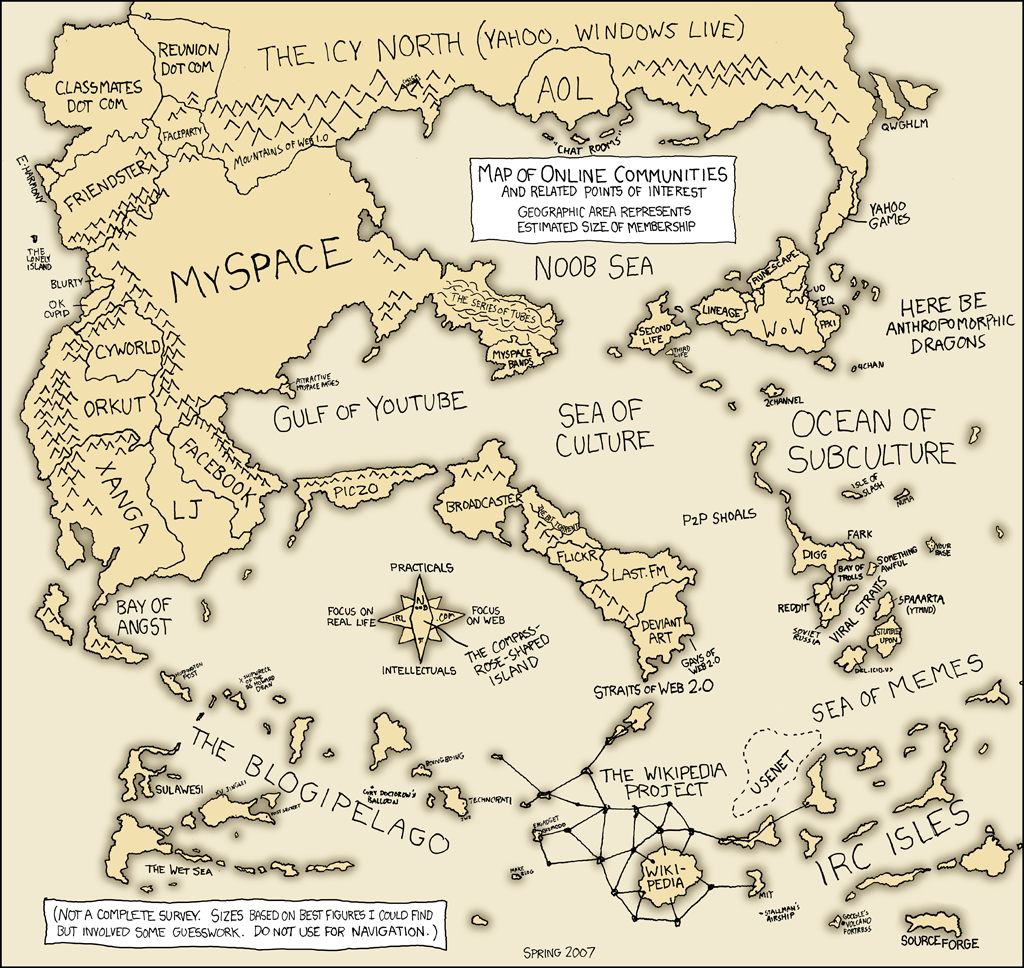
Via media-ocean I found an interesting map of the 'currently known' Social Web (a.k.a. Web 2.0). Here you might take a look at the map in full size. Interesting thing about, the sizes of the single areas (communities) on the map correspond to the approximate number of members. Also the layout has its purpose. On top, you'll find the 'practicals' (Yahoo, Windows Live...), while at the bottom there stick the 'intellectuals' (wikipedia, sourceforge,...). The left is more concerned about 'real life' (I'm missing XING...), while the right is more 'web centered' (second life, antropomorphic dragons, etc...). You can even find good old usenet ...but only as a dashed outline (maybe it is about (or has already) to vanishid and only remembered in old myths like the legendary Atlantis..)
Nice thing to notice, there's also Qwghlm....I can't remember having seen it on any map before :)

Friday, April 13, 2007

Tag search vs. keyword search......substitution or complement


As you know, collaborative tagging systems (CTS) have become rather popular Web 2.0 applications (although I don't like the term 'Web 2.0'...please use 'Social Web' instead). A CTS allows each registered user to maintain her own tags that add semantic annotation to corresponding web links. Today, 'tags' are simple unformatted text data. Tags are transporting meaning, i.e. semantics. Because the user is free to choose any text string (symbol) for a certain semantics (concept) related to a given resource (web page or object). To communicate this semantics, two or more users have to agree upon using the same symbols denoting an object (remember the semiotic triangle [1]).

First difficulty is syntax: there are several posibilities to write a word (of course not all of them are necessarely correct or not all of them belong to the same language). The problem becomes even worse, if one tries to combine several words in a single string (how to separate words?...use CamelCase, underscores, blanks, ...).
Next comes language dependent problems such as polysemy (homonyms or synonyms). For homonyms we have the same symbol but different meanings, and for synonyms vice versa.

Syntax and language dependent problems alone cause tag based search to be more difficult to handle than traditional keyword based approaches (by keyword based approach we refer to full text search or keywords assigned to the resource by the resource author or by some designated expert). For full text search, a query string given by the user (or at least its word stem) has to match some string being part of the searched resource. Keywords given to a resource by some designated expert should meet some level of objectivity and thus, a user might be able to 'guess' the keyword while thinking of a well suited query string. Keywords provided by the author refer to her specific point of view (same with tagging). These 'subjective' keywords are much harder to guess for the arbitrary user, because she does not necessarely share the same context with the (tag) author.
In CTS we distinguish several distinct categories of tags [2]. Among others, there are two fundamental different tag categories: descriptive tags and functional tags. Descriptive tags refer to more objective tags, tags that are used to describe a resource in some general maner. Functional tags on the other hand do include an intended functional use esp. for the tag author and thus, are more subjective. While descriptive tags serve better for general web search, functional tags are useful most for their authors, but not for other users.
To analyse the benefit of tagging for web search, we have to take into account that many users are providing tags for a specific resource. Depending on the distribution of the tags attached to a specific resource, one can observe a power law (see also [2]). Few tags are used very often, while most of all the tags attached to a resource do occur only scarcely. Those few tags rather often can be identified with descriptive tags, while the so called 'long tail' of the other tags often belong to the category of functional tags.
So, how can we make use f that fact?
In [3] the authors propose to use tags for search query refinement. For that reason, they distinguish between two defferent categores of tags (that do not necessarely correspondent with descriptive and functional tags). They distinguish search keywords as being the most popular tags assigned to a resource, which can help to increase the hit rate if being used for query refinement, and exploration keywords, which cannot. Because exploration keywords reflect the personalized search context and information need of an individual user they are supposed to be helpful for the exploration process.

Thursday, March 15, 2007

OSOTIS ...winning an iPod...and the CeBIT rumble starts again


I have already talked about the video search engine OSOTIS, but it has again improved over the time. First at all, what does 'OSOTIS' mean? No, it's not some sort of ancient egyptian god. It's just derived from the botanical name for 'forget-me-not', which is greek 'Myosotis'. So, the name already gives some hint for the offered service:
(1) OSOTIS offers search within videos
(2) right now, most videos available at OSOTIS are academic lecture recordings, ranging from short viseo sequences from the famous Solvay conference in 1927 (where Einstein replied to Bohr that God does not throw dice...) up to lectures from Berkeley, MIT, Stanford, Oxford, or also my lectures at the Friedrich-Schiller-University in Jena (Germany).
(3) OSOTIS does not host the videos (as youTube or Google does). They only provide links to your resources. Nevertheless, OSOTIS downloads the offered video stream for post processing and for generating timed annotations for the video serch.
(4) You can register at OSOTIS (btw if you register before April 15th you have the chance to win an iPod 30GB) and maintain your own video collections, maintain an own user profile, make friends, choose your favourite videos, and (!) you can tag videos.
(5) You can even tag inside video streams. This means that the tagging information also includes time information and that the search is able to replay the video exactly from the right position.
(6) OSOTIS is a social networking tool.
And OSOTIS is at the CeBIT computer fair that has just opened its gates. Visit us at hall 9, D04!
Yes...and tomorrow I will be at CeBIT in Hannover for the next three days. So just stay tuned, because I will write about everything interesting that comes into my way.

Thursday, November 09, 2006

International Semantic Web Conference 2006 (ISWC 2006), Athens (GA), USA - Day 2


Wednesday...the 2nd day of ISWC started with a keynote of Jane E. Fountain from the University of Massachussetts in Amherst about 'The Semantic Web and Networked Governance'. From her point of view, Governements have to be considered as major information processing [and knowledge creating] entities in the world, and she was trying topoint out the key challenges faced by governements in a networked world (for me the topic was not that interesting...). Also today's sessions - at least those that I have attended - were not that exciting. I liked one presentation given by Natasha Noy from Stanford on 'A Framework for Ontology Evolution in Collaborative Environments' in the 'Collaboration and Cooperation' session. She presented an extension of the protégé ontology editor for collaborative ontology development.
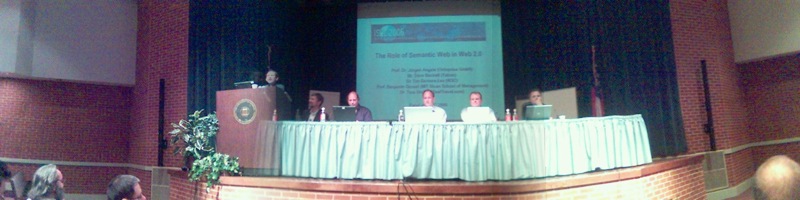
The most interesting session for me was the 'Web 2.0' panel in the afternoon. Amon the panelist were Prof. Jürgen Angele (Ontoprise), Dave Beckett (Yahoo!), Sir Tim Berners-Lee (W3C), Prof. Benjamin Grosof (MIT Sloane School of Management), and Tom Gruber. The panelwas discussing the role of semantic web technology for web 2.0 applications.


Jürgen Angele pointed out that the only thing that is really new about web 2.0 is ad-hoc remixability. Everything else is nothing but 'old' technology. But, as he stated, web 2.0 could be a driving force for semantic web technology.

Dave Beckett made some advertising for Yahoo! in the sense that he was pointing out that Yahoo! indeed is making use of semantic web technology (at least in their new system called Yahoo!Food) and Yahoo! is a great participation platform with more than 500 million visitors per month.

Tim Berners-Lee gave a survey on the flaws and drawbacks of web 2.0 and how semantic web technology could help. While web 2.0 is not able to provide real inter-application integration, the semantic web on the other side does not provide such cool interfaces to data. Together both in combination, they could become interesting.
All so called new aspects of web 2.0 have already been the goals of the original web (1.0), as easy creation of content, collaborative spaces, intercreativity, collective intelligence from designing together, creating relationships, reuse of information, and of course user-generated content. Web 2.0 architecture consists of client side (AJAX) interaction and server side data processing (aka the good old 'client-server'-paradigm) and mashups (one per application / each needs coding in javascript, each needs scraping/converting/...). Essentially, web 2.0 is fully centralized. So, why are skype, del.icio.us, or flickr websites instead of protocols (as foaf is)? The reuse of web 2.0 data is only limited to the hostside. Only with the help of feeds, data are able to break out from centralized sites. What will happen with all of your tags? Will they end up as simply being words or will they become real (and usefull) URIs?
With semantic web technology, web 2.0 enables multiple identities for you. You may have many URIs, enabling you to access different sorts of data, to fullfill different expectations concerning trust, accuracy, and persistence. In the end, web 2.0 and semantic web while being good seperately could be great together!

Benjamin Grosof asked, where semantic web technology could help web 2.0. He focused on backend semantic integration and mediation (augment your information via shallow inferences), collaboration and semantic search. Semantic search will enable you a morhuman centered search interface, as e.g., 'Give me all recipes of cake....but I don't like any fruits' and 'I want a good recommendation from a well reputed web site'. He sees semantic web technology piggyback on web 2.0 interactions ('web 2.0 = search for terrestrial intelligence in the crowd' :) The semantic web should exploit web 2.0 to obtain knowledge.

Tom Gruber was asking 'Where is the mojo in Web 2.0?'. He characterized web 2.0 as being a fundamentally democratic architecture, driven by social and entertainment payoffs (universal appeal...), while the web 1.0 business model actually keeps working ('attention economy'). He was discussing the way from today's 'collected intelligence' to real 'collective intelligence'. He concluded 'don't ask what the web knows....ask what the world knows!' and 'don't make the web smart...make the world smart'.

Wednesday, November 08, 2006

International Semantic Web Conference 2006 (ISWC 2006), Athens (GA), USA - Day 1


Tuesday morning 9 a.m. ... the ISWC 2006 starts with the keynote of Tom Gruber (godfather of computer science based definition of the term 'ontology') on 'Where the Social Web Meets the Semantic Web'. He focused on 'Collective Intelligence' as being the reason that companies as google or amazon did survive the first Dot-com bubble, because they where making use of their users' collective knowledge. Google uses other people's intelligence by computing a page rank out of the users' links to other webpages. Amazon uses the people's choices for their recommentation system, and ebay uses the people's reputation. Interesting thing about that is that the notion of 'Collective Intelligence' (aka 'Social Web', aka 'Web 2.0') - was already addressed by Douglas Engelbart in the late 60's. Engelbart did not only invent the mouse, the window-based user interface, and many other important things that are part of today's computing environment, his driving force - as Gruber said - was 'Collective Intelligence'....to cope with the set of growing problems that humanity is facing today. Thus - as I have also stated in another post - also the semantic web depends on collaboration and participation of the users and therfore, on 'Collective Intelligence' to become a success.

BTW, I prefer using the term 'Social Web' instead of 'Web 2.0'. From my point of view 'Social Web' hits exactly the point and does not suggest any new and exciting technology (but only the fact that people are using existing web technology in a collaborative way to interact with each other).

After the keynote I visited the 'Knowledge Representation' session with an interesting talk of Sören Auer on OntoWiki (a semantic wiki system .. interesting, because one of my students is alsoimplementing a semantic wiki). In the afternoon sessions I esp. liked the talks about representation and visualization (esp. the talk of Eyal Oren on 'Extending faceted navigation for RDF data', where he presented a nice server application that is able to visualize arbitrary RDF-data). In the evening, a dinner buffet (including cuban music) was combined with the poster sessions and the 'Semantic Web Challenge' exhibition, where I found the possibility for a cooperation with Siegfried Handschuh from DERI (on semantic authoring and annotation....).

Oh...I already forgot to mention that there is also a flickr group with ISWC photographs...

Wednesday, October 25, 2006

From Web to Semantic Web - the 'Missing Link'


Starting with WebMonday's keynote in September the topic seems to get more attention every day (see also the discussion Markus Trapp's blog entries on Semantic Web and Web 2.0...). Web 2.0 almost seems to have reached the top in Gartner's hype cycle, and for sure you will have noticed that purchasing Web 2.0 companies has become rather expensive. Are we chasing a new bubble? But, that's another question that I won't discuss today.
I want to emphasize the thesis that for becoming a success 'Semantic Web' depends on 'Web 2.0 paradigms'.
Just follow this simple train of thoughts:

  1. The 'Semantic Web' assumes the web pages to provide semantic annotation, i.e. subjects discussed in the web page are linked to semantic metadata (ontologies) that provides well defined meaning to be processable by machines.
  2. The current Web comprises billions of web pages (at least more than 20 billion web pages seem to be indexed by Google).
  3. How to annotate billions of web pages?
    (a) Currently, there's no way to annotate web pages automatically. A sound semantic annotation is only possible with true text understanding.
    (b) Of course, authors might provide annotations for their own web pages. Even if there would be efficient tools for manual annotation, there are still billions of 'old' web pages that also have to be annotated.
    (c) So why not engage all web users? Just think of wikipedia... If there would be tools for collaborative semantic annotation of web pages, the users are able to annotate the web pages that are of interest for them.
Thus, depending on the assumption that (a) there are alredy sound ontologies available and (b) there are tools for collaborative annotation, the annotation of billions of already existing web pages seems viable.

Just think of corrent collaborative tagging systems (CTS). Although its deficiencies collaborative tagging shows the way, how to provide metadata in a collaborative way.