Showing posts with label archive. Show all posts

Tuesday, July 20, 2010

Visualizing video archive content -- arte.tv

Okay, first at all, it's been a while that I have written a blog post here. I guess that's some tribute to the ever faster spinning world of digital media as I had concentrated more on shorter and therefore, faster means of communication such as twitter and (shame on me...) facebook. Nevertheless, while skipping through the pages of moresemantic I decided to revive the blog and to keep on posting about current research work....

This morning, I had to look up a documentary 'The Digital Bomb', which had been broadcasted yesterday evening on the German/French arte television channel. Arte is one of the public service television channels focussing on culture and arts. As many other television broadcasters, arte of course maintains a website and being as a television broadcaster there is also some sort of media archive. As being a public service television broadcaster, some strange regulations keep the archive from maintaining more than 7 days of tv-program -- but this is something completely different (as to speak with Monty Python). This morning, I made some discoveries in arte's tv archive, esp. about their way of visualizing content.

Besides being a little bit difficult to find the right mode of access -- esp. if you are looking for a specific date of broadcast, I succeeded in finding this nice portal page showing the most featured videos of yesterday's tv program including a timeline (at the top) for growing back (and forth) in time. I really like the 2-D tile pattern relating the size of the videos (represented by some significant key frame) to their popularity (or any other ranking). When you place the mouse pointer over a frame you will get more detailed information about the video and by clicking on it the video opens for reviewing.

All in all it seems to be inspired by the TED video archive and there's still room for improvement. I would like to see also timelines for shown content (not only broadcast or production date) as well as geographical information about production/content shown in interactive maps.

Now I have become curious about what else is out there? Any new innovative, interactive visualizations for displaying video archive content aside from the youtube mainstream??

Tuesday, July 29, 2008

Happy 50th Birthday NASA

Well, NASA, the National Aeronautics and Space Administration, celebrates its 50th birtday. On July 29th, 1958 US-President Eisenhower signed the „National Aeronautics and Space Act“ and NASA started to work on October 1st, 1958. Just a few months earlier in autumn 1957, the Soviet Union launched the very first artificial satellite SPUTNIK 1, resulting in the so called "Sputnik shock", paraphrasing that the western world was shocked that the USSR was really able to do this...and by doing so the entire western world (esp. USA) was commited to an atomic thread. We all know the story of the Cold War.... (BTW, for this reason Eisenhower also founded ARPA, the "mother" of the Internet).
The race began and now, 50 years later, Russian and US-american astronauts are working together in the International Space Station ISS.

Although I'm quite younger than NASA, NASA made a big impression on my childhood days. Remember the Apollo program and the first man on the moon. As almost every child I wanted to become an astronaut - or at least a scientist (got it!). Belief it or not, my very first memories of television are pre-launch cuntdowns of the Apollo Program (I really don't know which mission, but obviously one of the later). I remember the countdown was stopped several times and I was very angry, because I had to go to bed and could not watch the lift-off. I dimly remember even the Skylab program (as well as its early "re-entry" in 1979) and of course the first launch of the Space Shuttle in 1981 (and again with delayed countdown..., at Google Video you may watch the lift-off video of STS-1 Columbia).

But, the most interesting thing for me always have been NASA's planetary missions, giving us wonderful pictures of Jupiter or Saturn (Pioneer and Voyager) and the other planets.

NASA has opend up its Picture Archive with tons of pictures for free use. Nicely organized you may find pictures from Hubble, planetary missions, the space program, and many more....(But beware, today their servers have to keep up with an intense workload because of their birthday event).

Thursday, June 19, 2008

Smithsonian's Photographic Archive at flickr!

The Smithsonian's photographic Archive (at least parts of it) is available at flickr! The pictures are in high-resolution und published under Flickr commons copyright regulations, i.e. copyright-free.

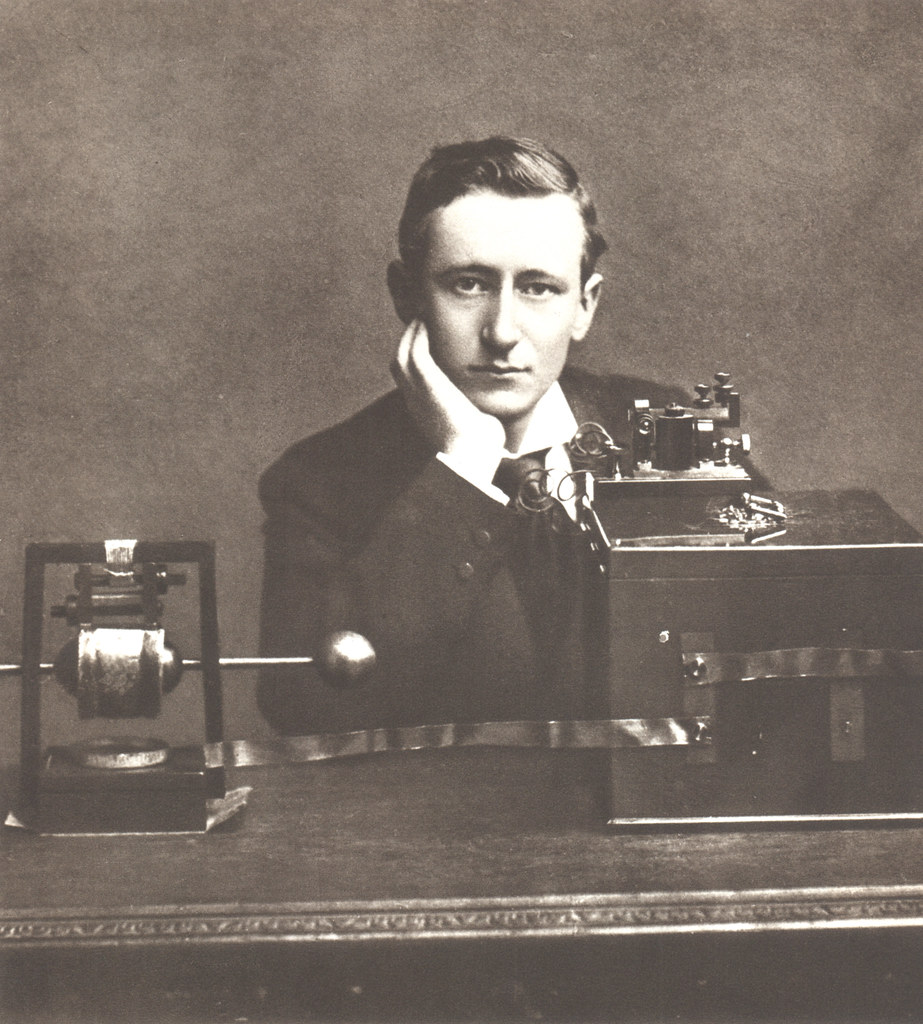
Most interesting is the Folder 'Portraits of Scientists and Inventors' including many famous scientists from the 19th century (including G. Marconi from the upper left corner...). The pictures are from the Smithsonian Dibner Library of the History of Science and Technology that has a collection of more than a thousand portraits of scientists and inventors through the centuries. Only a small sampling of 144 pictures of the collection is available at flickr and gives you an idea of the range of the collection. Visit “Scientific Identity: Portraits from the Dibner Library” to see the entire collection.

Other interesting folders include 'Portraits of Artists' or 'People and the Post' from the Smithsonian's National Post Museum.

[via boing boing]