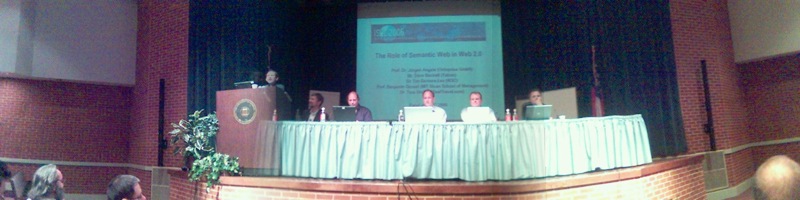
Wednesday...the 2nd day of ISWC started with a keynote of
Jane E. Fountain from the University of Massachussetts in Amherst about '
The Semantic Web and Networked Governance'. From her point of view, Governements have to be considered as major information processing [and knowledge creating] entities in the world, and she was trying topoint out the key challenges faced by governements in a networked world (for me the topic was not that interesting...). Also today's sessions - at least those that I have attended - were not that exciting. I liked one presentation given by
Natasha Noy from
Stanford on '
A Framework for Ontology Evolution in Collaborative Environments' in the 'Collaboration and Cooperation' session. She presented an extension of the protégé ontology editor for collaborative ontology development.
The most interesting session for me was the '
Web 2.0' panel in the afternoon. Amon the panelist were Prof.
Jürgen Angele (Ontoprise),
Dave Beckett (Yahoo!),
Sir Tim Berners-Lee (W3C), Prof.
Benjamin Grosof (MIT Sloane School of Management), and
Tom Gruber. The panelwas discussing the role of semantic web technology for web 2.0 applications.

Jürgen Angele pointed out that the only thing that is really new about web 2.0 is ad-hoc remixability. Everything else is nothing but 'old' technology. But, as he stated, web 2.0 could be a driving force for semantic web technology.
Dave Beckett made some advertising for Yahoo! in the sense that he was pointing out that Yahoo! indeed is making use of semantic web technology (at least in their new system called
Yahoo!Food) and Yahoo! is a great participation platform with more than 500 million visitors per month.
Tim Berners-Lee gave a survey on the flaws and drawbacks of web 2.0 and how semantic web technology could help. While web 2.0 is not able to provide real inter-application integration, the semantic web on the other side does not provide such cool interfaces to data. Together both in combination, they could become interesting.
All so called new aspects of web 2.0 have already been the goals of the original web (1.0), as easy creation of content, collaborative spaces, intercreativity, collective intelligence from designing together, creating relationships, reuse of information, and of course user-generated content. Web 2.0 architecture consists of client side (AJAX) interaction and server side data processing (aka the good old
'client-server'-paradigm) and mashups (one per application / each needs coding in javascript, each needs scraping/converting/...). Essentially, web 2.0 is fully centralized. So, why are skype, del.icio.us, or flickr websites instead of protocols (as
foaf is)? The reuse of web 2.0 data is only limited to the hostside. Only with the help of feeds, data are able to break out from centralized sites. What will happen with all of your tags? Will they end up as simply being words or will they become real (and usefull) URIs?
With semantic web technology, web 2.0 enables multiple identities for you. You may have many URIs, enabling you to access different sorts of data, to fullfill different expectations concerning trust, accuracy, and persistence. In the end, web 2.0 and semantic web while being good seperately could be great together!
Benjamin Grosof asked, where semantic web technology could help web 2.0. He focused on backend semantic integration and mediation (augment your information via shallow inferences), collaboration and semantic search. Semantic search will enable you a morhuman centered search interface, as e.g., 'Give me all recipes of cake....but I don't like any fruits' and 'I want a good recommendation from a well reputed web site'. He sees semantic web technology piggyback on web 2.0 interactions ('
web 2.0 = search for terrestrial intelligence in the crowd' :) The semantic web should exploit web 2.0 to obtain knowledge.
Tom Gruber was asking 'Where is the mojo in Web 2.0?'. He characterized web 2.0 as being a fundamentally democratic architecture, driven by social and entertainment payoffs (universal appeal...), while the web 1.0 business model actually keeps working ('attention economy'). He was discussing the way from today's 'collected intelligence' to real 'collective intelligence'. He concluded '
don't ask what the web knows....ask what the world knows!' and '
don't make the web smart...make the world smart'.