Showing posts with label Tim Berners-Lee. Show all posts

Monday, April 09, 2007

Tim Berners-Lee: The Web - Looking Back, Looking Forward


Another talk given by Tim Berners-Lee on 13th March 2007 in London as keynote on the start of this year's prestigious BCS Lovelace lecture. Tim Berners-Lee was granted the Lovelace Medal (named after Ada Lovelace, the daughter of Lord Byron and founder of scientific computing) in 2006. Here is the interview entitled 'Isn't it semantic?' from 2006 with TBL on winning the Lovelace medal. Usually the winner of the Lovelace medal has to give a lecture in the following year, and thus, this years Lovelace lecture is given by Berners-Lee.

The Lovelace Medal is presented to individuals who have made a contribution which is of major significance in the advancement of Information Systems or which adds significantly to the understanding of Information Systems. Among the winners are rather famous computer scientists such as Douglass Engelbart, inventor of the computer mouse and pioneer of GUI, networking, and hypertext systems, who received the medal in 2001, or Linus Torvalds, developer of the LINUX operating system, who received the award in 2000.

(video discovered at Serge Linckels)

Tuesday, April 03, 2007

Tim Berners-Lee: The Semantic Web of Data


Tim Berners-Lee is talking about 'The Semantic Web of Data' in a video at Technology Review. In this short presentation the inventor of the world wide web is trying to explain in short, what the Semantic Web is all about, and how it will affect our way to look at data, to understand data, and to work with data (it's all about integration of heterogeneous data...).
('video found at Semantic Bits)

Saturday, January 13, 2007

...against all odds


On wednesday I attended a talk given by Michael Strube from EML Research on "World Knowledge induced from Wikipedia - A New Prospect of Knowledge-Based NLP ". He was showing how the (meanwhile famous) collaborative encyclopedia can be used for information retrieval purposes in a way similar to (more traditional) online dictionaries as e.g. WordNet and - though being not well structured - provides results of almost equal quality.
First thing was that for their work, Strube and his colleague regarded each Wikipedia page as being the representation of a concept (we already had some arguments about that as you might remember...). Next, they developed some metric for similarity of concepts w.r.t. to the concept hierarchy (where the wikipedia defined 'concepts' come into play). Since 2004, wikipedia features a user defined concept hierarchy. This hierarchy of concepts also can be regarded as being a folksonomy, simply because this is not a knowledge representation carefully designed by some designated domain expert, but by the wikipedia comunity in a collaborative way. Unfortunately, the wikipedia concept hierarchy suffers exactly from that fact. From my pont of view it seems problematic to compare the proposed similarity measure (based on wikipedia concept hierarchy) with other similarity measures (based on commonly shared expert ontologies). O.k., you might argue that indeed the wikipedia concept hierarchy IS commonly shared, because it has been developed by the wikipedia community...but is the knowledge represented in wikipedia really 'common'? Just remember the diversity and manifold of Star Wars characters or Star Trek episodes in wikipedia compared with, as e.g., the history of smaller Eropean countries. As for all ontologies always the view and the knowledge of the ontology designer has to be considered. The wikipedia concept hierarchy - although partly being really appropriate - reminds me somehow to this famous literary chinese dictonary entry defining the term 'animal' which is quoted by Jorge Luis Borges. Another problem lies in the fact that the different language versions of wikipedia have developed different concept hierarchies (sic!).

In the end, I was asking how this proposed information retrieval based on wikipedia could be improved by considering a 'Semantic Wikipedia', as e.g., the Semantic MediaWiki (given that those semantic wikipedias would contain sufficient data). Instead of answering my question, Michael Strube cited Peter Norwig's argument against the Semantic Web from last years AAI2006. Just to sum up: the semantic web will not become reality because of the inability of its users to provide correct semantic annotations. But hey...this guy (Strube) was talking about wikipedia. Doesn't this argument raise any associations? Just remember the time 5 or 10 years ago. Nobody (well almost nobody) would have believed that it will be possible to write an entire encyclopedia collaboratively on an open source basis - just because the web user's did not seem to be able to write 'correct' articles....

Wednesday, November 15, 2006

International Semantic Web Conference 2006 (ISWC 2006) - Aftermath


Back home again, jetlag is almost gone while already travelling to Potsdam again for a talk on 'Semantic Annotation in Use'....After all, ISWC 2006 was a very nice and interesting conference...although being set up at a rather remote location (at least from my point of view). One of its highlights (as already pointed out) was the panel discussion about web 2.0 and semantic web. Leo Sauermann was raising the question, why there is such a bad marketing of semantic web technology. Obviously - as TBL was replied - because the W3C invests all funding into hiring scientist and not marketing people. One of the major problems is that semantic web applications don't look 'cool' and 'sexy' ... and therefore, they don't get public attention. BTW, right at the same time, the 3rd Web 2.0 conference took place in San Francisco. Why did the conference organizers of ISWC not try to organize a panel discussion with a live connection between the two conferences? At ISWC of course there were only 'Semantic Web'-people and (at least as far as I have realized) nobody from the 'Web 2.0'-community. Allright, you can be both SemWeb and Web2.0. But, as long as you are are focused on Semantic Web most people will have common focus (and argument) on Web 2.0. Another point of view for sure would have been interesting to listen to.

Closely related to the lack of marketing question is the question about the Semantic Web killer application. Nobody knows what type of application it will be - of course ... otherwise the application would already be there. But, as for all killer applications, it will not necessarely be somthing 'really' useful :) If you consider that the killer application for the WWW (at least for the time in its early beginnings back at CERN) was the 'telephone book'. Not to mention the sms and the mobile phone. Maybe the semantic web killer application will be related to rather ordinary applications such as a dating service that is really able to find a match....

BTW, I have switched to the new beta release of blogger.com... (comments should be working now - at last! - and also keywords)...and the other guy on the picture is Ulrich Küster (also from FSU Jena) at the ISWC dinner reception...

Thursday, November 09, 2006

International Semantic Web Conference 2006 (ISWC 2006), Athens (GA), USA - Day 2


Wednesday...the 2nd day of ISWC started with a keynote of Jane E. Fountain from the University of Massachussetts in Amherst about 'The Semantic Web and Networked Governance'. From her point of view, Governements have to be considered as major information processing [and knowledge creating] entities in the world, and she was trying topoint out the key challenges faced by governements in a networked world (for me the topic was not that interesting...). Also today's sessions - at least those that I have attended - were not that exciting. I liked one presentation given by Natasha Noy from Stanford on 'A Framework for Ontology Evolution in Collaborative Environments' in the 'Collaboration and Cooperation' session. She presented an extension of the protégé ontology editor for collaborative ontology development.
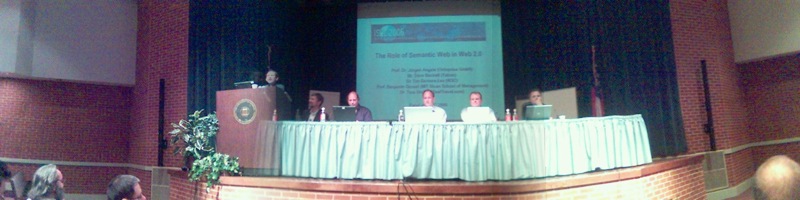
The most interesting session for me was the 'Web 2.0' panel in the afternoon. Amon the panelist were Prof. Jürgen Angele (Ontoprise), Dave Beckett (Yahoo!), Sir Tim Berners-Lee (W3C), Prof. Benjamin Grosof (MIT Sloane School of Management), and Tom Gruber. The panelwas discussing the role of semantic web technology for web 2.0 applications.


Jürgen Angele pointed out that the only thing that is really new about web 2.0 is ad-hoc remixability. Everything else is nothing but 'old' technology. But, as he stated, web 2.0 could be a driving force for semantic web technology.

Dave Beckett made some advertising for Yahoo! in the sense that he was pointing out that Yahoo! indeed is making use of semantic web technology (at least in their new system called Yahoo!Food) and Yahoo! is a great participation platform with more than 500 million visitors per month.

Tim Berners-Lee gave a survey on the flaws and drawbacks of web 2.0 and how semantic web technology could help. While web 2.0 is not able to provide real inter-application integration, the semantic web on the other side does not provide such cool interfaces to data. Together both in combination, they could become interesting.
All so called new aspects of web 2.0 have already been the goals of the original web (1.0), as easy creation of content, collaborative spaces, intercreativity, collective intelligence from designing together, creating relationships, reuse of information, and of course user-generated content. Web 2.0 architecture consists of client side (AJAX) interaction and server side data processing (aka the good old 'client-server'-paradigm) and mashups (one per application / each needs coding in javascript, each needs scraping/converting/...). Essentially, web 2.0 is fully centralized. So, why are skype, del.icio.us, or flickr websites instead of protocols (as foaf is)? The reuse of web 2.0 data is only limited to the hostside. Only with the help of feeds, data are able to break out from centralized sites. What will happen with all of your tags? Will they end up as simply being words or will they become real (and usefull) URIs?
With semantic web technology, web 2.0 enables multiple identities for you. You may have many URIs, enabling you to access different sorts of data, to fullfill different expectations concerning trust, accuracy, and persistence. In the end, web 2.0 and semantic web while being good seperately could be great together!

Benjamin Grosof asked, where semantic web technology could help web 2.0. He focused on backend semantic integration and mediation (augment your information via shallow inferences), collaboration and semantic search. Semantic search will enable you a morhuman centered search interface, as e.g., 'Give me all recipes of cake....but I don't like any fruits' and 'I want a good recommendation from a well reputed web site'. He sees semantic web technology piggyback on web 2.0 interactions ('web 2.0 = search for terrestrial intelligence in the crowd' :) The semantic web should exploit web 2.0 to obtain knowledge.

Tom Gruber was asking 'Where is the mojo in Web 2.0?'. He characterized web 2.0 as being a fundamentally democratic architecture, driven by social and entertainment payoffs (universal appeal...), while the web 1.0 business model actually keeps working ('attention economy'). He was discussing the way from today's 'collected intelligence' to real 'collective intelligence'. He concluded 'don't ask what the web knows....ask what the world knows!' and 'don't make the web smart...make the world smart'.

Wednesday, November 08, 2006

International Semantic Web Conference 2006 (ISWC 2006), Athens (GA), USA - Day 1


Tuesday morning 9 a.m. ... the ISWC 2006 starts with the keynote of Tom Gruber (godfather of computer science based definition of the term 'ontology') on 'Where the Social Web Meets the Semantic Web'. He focused on 'Collective Intelligence' as being the reason that companies as google or amazon did survive the first Dot-com bubble, because they where making use of their users' collective knowledge. Google uses other people's intelligence by computing a page rank out of the users' links to other webpages. Amazon uses the people's choices for their recommentation system, and ebay uses the people's reputation. Interesting thing about that is that the notion of 'Collective Intelligence' (aka 'Social Web', aka 'Web 2.0') - was already addressed by Douglas Engelbart in the late 60's. Engelbart did not only invent the mouse, the window-based user interface, and many other important things that are part of today's computing environment, his driving force - as Gruber said - was 'Collective Intelligence'....to cope with the set of growing problems that humanity is facing today. Thus - as I have also stated in another post - also the semantic web depends on collaboration and participation of the users and therfore, on 'Collective Intelligence' to become a success.

BTW, I prefer using the term 'Social Web' instead of 'Web 2.0'. From my point of view 'Social Web' hits exactly the point and does not suggest any new and exciting technology (but only the fact that people are using existing web technology in a collaborative way to interact with each other).

After the keynote I visited the 'Knowledge Representation' session with an interesting talk of Sören Auer on OntoWiki (a semantic wiki system .. interesting, because one of my students is alsoimplementing a semantic wiki). In the afternoon sessions I esp. liked the talks about representation and visualization (esp. the talk of Eyal Oren on 'Extending faceted navigation for RDF data', where he presented a nice server application that is able to visualize arbitrary RDF-data). In the evening, a dinner buffet (including cuban music) was combined with the poster sessions and the 'Semantic Web Challenge' exhibition, where I found the possibility for a cooperation with Siegfried Handschuh from DERI (on semantic authoring and annotation....).

Oh...I already forgot to mention that there is also a flickr group with ISWC photographs...