Friday, May 25, 2007

Copyright and Fair Use....

I have found an amazing videoclip about copyright. In his short movie "A Fair(y) Use Tale... Professor Eric Faden from Bucknell University addresses the question of fair use and the copyright law in a humorous but informative way. Interesting thing about is that the entire movie is sampled from short Disney movie clips....and thus subject to copyright law. If the video is deleted from youtube, it can be also retrieved from Stanford Center for Internet and Society.
[found via telepolis]

Tuesday, May 15, 2007

Next Generation Search Engines revisited...

As reader of my blog for sure you know that one of the main topics is (semantically enhanced) searching the web. Recently I was rereading Andrei Broder's short paper on 'A taxonomy of web search'[1], where he was also referring to the three generations of web search engines. His article dates back to 2002. Environment and technology in the web are rapidly changing. So, what about this three generations? Do we already need a 'next generation'? And what about the discussion about 'Search 2.0'?...
But first, let's recall the three generations according to Broder:

  • First generation: search engines are useing almost only on-page data such as text and formatting information to compute result ranking (1995-1997, cf. Alta Vista, Excite, etc...).

  • Second generation: search engines are using off-page, web-related data such as link analysis, anchor-texts, and click-through data (1998-..., cf. Google).

  • Third generation: search engines try to blend data from multiple, heterogeneous sources trying to answer 'the need behind the query'. The computed results are customized according to the user's information needs, taking into account the user's personal data background, context, and intention (now? - ...).

Clearly, search engines of the third generation include social networking information, tagging, user feedback, semantic analysis, recommendations, and trustworthyness of information (according to its source).
In read/write web the topic is also addressed as comparison of traditional search technologies with what they call 'Search 2.0' [2]. As usual, I don't like the 2.0-term. What is discussed there, refers to Broder's definition of 'Third generation' and adds nothing significant new to it (besides the marketing term). But, the article is definitely worth reading, because a lot of recent search engines are referenced and discussed (and also because of the interesting discussion that follows). They distinguish between 'Finding' information and 'Discovering' information, while relating the second term to 'Search 2.0'.

Broder distinguishes different sorts of web search queries:

  1. Navigational: intented use is to reach a particular web page (similar to 'known item' search in classical information retrieval). Therefore, navigational queries usually do have only one 'right' result.

  2. Informational:
  3. intended use is to acquire information assumed to be present on one or more web pages (as in classical information retrieval).
  4. Transactional:
  5. intended use is to find a web page, where further transactions (e.g. shopping) will take place.

If we take social bookmarking services, navigational queries can be computed simply by using the user's personomy (i.e. the set of all tags used by a distinct user). If the goal is to find a web page, which has been already accessed in the past, the page might be found quickly, if the user has registered the page within the bookmarking service (which comes to 'Finding' information). But, the query might also be resolved by using other people's tags, if somebody has tagged the page (with objectively descriptive tags).
Social bookmarking services are also usefull for the other two purposes. In addition, if the page is found, the social networking information can be utilized for 'discovering' new, previously unkown, but related (similar) information (which comes to 'Discovering' information). Hotho et al. present an adaptive ranking algorithm (FolkRank) for social bookmarking systems and discuss the problems that arise for tag-based search engines [3].

But, to answer the 'need behind the query' as Broder states in his definition of 'Third generation search engines', further personalization is mandatory. Only, if the search engine is able to find out the context of a query w.r.t. a given user and a given situation (i.e. even the same user might have different information needs in different situations), then it is possible to grasp the actual context of the query, and thus, also the 'need behind the query'...
[to be continued]

References:
[1] Andrei Broder: A taxonomy of web search, SIGIR Forum 36, pp. 3-10, 2002.
[2] Ebrahim Ezzy, Richard MacManos: Search 2.0 vs. Traditional Search, read/write web, June 20th, 2006.
[3] Andreas Hotho, Robert Jäschke, Christoph Schmitz and Gerd Stumme: Information Retrieval in Folksonomies: Search and Ranking, in Proceedings of the 3rd European Semantic Web Conference, pp. 411-426, 2006.

Tuesday, May 08, 2007

J.D. Salinger - Neun Erzählungen

J.D. Salinger ist sicherlich nicht nur für mich ein ganz besonderer Erzähler. Wie viele andere auch, habe ich seinen großen Roman "Der Fänger im Roggen" bereits in der Schule gelesen. Nicht, weil wir diesen im Englischunterricht lesen mussten, sondern weil mich die Erzählungen meiner Bekannten aus dem Englisch-LK (man stelle sich vor, ich konnte Englisch als Fremdsprache abwählen und habe Latein als Abiturfach gewählt...) irgendwie neugierig darauf gemacht hatten. Natürlich habe ich mich damals mit meinen beschränkten Englischkenntnissen (sic!) nicht an die Originalausgabee gewagt, sondern hatte mit der Böll-Übersetzung Vorlieb nehmen müssen (ohne zu wissen, dass die Übersetzung von Heinrich Böll war). Trotz aller Schwächen der deutschen Übersetzung hat mich der Roman damals fasziniert, glaubte ich doch in diesem Roman erkannt zu haben, was es ausmacht, eine gute Geschichte zu schreiben (zumindest damals und in meinen Augen...). Irgendwie passiert ja auch nicht wirklich etwas in diesem Roman, der ja eigentlich auch nur eine auf Romanlänge aufgeblasene Kurzgeschichte ist.

Holden Caufield, der "zerbrechlich" wirkende und stets altklug daherredende Held dieser Geschichte aus den 50er Jahren ist aus dem Internat herausgeflogen und vorzeitig - es ist bald Weihnachten - auf dem Weg nach Hause nach New York - ohne natürlich gesteigerten Wert darauf zu legen, in die offenen Arme seiner Eltern zu laufen. Aber das ganze ist ja eigentlich nur ein Rahmen für viele kleine Erzählungen....alles Erzählungen, die von "verpassten" Gelegenheiten und Chancen erzählen. Immer wieder gerät Caufield in eine vielversprechende, entscheidende Situation und das "was-wäre-wenn" geht auf der einen Seite dem Romanhelden und auf der anderen Seite natürlich auch dem Leser durch den Kopf....ohne dass der Romanheld die ihm gebotene Gelegenheit, der Geschichte einen anderen Ausgang zu geben, jemals ergreifen würde. So ist der Leser irgendwie enttäuscht, aber auf der anderen Seite fühlt man sich gekitzelt oder vielmehr angestachelt, um zu sehen, welche Möglichkeiten die nächste Situation birgt, in der Salinger seinen Helden geraten lässt, und ob er diesmal nicht vielleicht doch etwas daraus macht....

Etwas anders ist es in diesem Band mit 9 frühen Kurzgeschichten Salingers (allesamt erschienen vor dem 'Fänger im Roggen'), in der er auch viel Biographisches verarbeitet. Wie üblich passiert in den Geschichten auch nicht wirklich etwas. Aber es ist diese Atmosphäre... Stets schafft es Salinger, eine Art Melancholie über Allem schweben zu lassen. Es kommt gar nicht darauf an, was seine Figuren tatsächlich tun und wie sie agieren. Vielmehr sind es die Dialoge bzw. die inneren Monologe, die seine Figuren führen und die sie so besonders machen. Die Nebensächlichkeiten, die in diesen kurzen Episoden zur Hauptsache werden, die fragile Verletzlichkeit der Figuren, das Sich-verlieren in Oberflächlichkeiten, die doch so vieles bedeuten....Ähnliches kennt man aus den Kurzgeschichten von Raymond Carver, der sich Salinger sicherlich auch als Vorbild genommen hatte (besonders zu empfehlen ist die Kurzgeschichtensammlung 'What We Talk about When We Talk about Love').

Die meisten Geschichten von Salinger haben etwas mit dem Erwachsenwerden zu tun. Die Spannung, die sich aus dieser Potentialdifferenz ergibt, wenn die handelnde Figur auf der Schwelle zwischen beiden Welten steht, das Erkennen, dass die Lüge einen Stellenwert in der Welt der Erwachsenen besitzt, vor der man nur als Kind gefeit zu sein scheint....

So ist erste Geschichte "A perfect day for banana-fish" des vorliegenden Buches eine besonders düstere und bizarre Geschichte. Eine der ersten Geschichte, die Salinger 1948 im "New Yorker" veröffentlicht hat und die ihn über Nacht bekannt machte. Der Protagonist der Geschichte ist ein scheinbar etwas verwirrter Kriegsveteran, freundet sich im Urlaub mit einem kleinen Mädchen an und erzählt ihr am Strand eine Geschichte von Bananenfischen. Dann geht er zurück auf sein Hotelzimmer, legt sich zu seiner schlafenden Frau ins Bett und jagt sich eine Kugel in den Kopf....

Salinger bleibt, obwohl er als einer der meistgelesenen (und meistinterpretierten) amerikanischen Autoren gilt, ein ungewöhnlicher, irgendwie nicht greifbarer Charakter. Er nahm an einigen der heftigsten Schlachten des 2. Weltkriegs teil, so etwa bei der Landung der Aliierten in der Normandie oder auch in den Ardennen. Tatsächlich war er auch selbst aufgrund eines Kriegstraumas kurzzeitig in Behandlung. Während seiner Zeit in Europa traf er auf Ernest Hemingway, der als Kriegsberichterstatter teilnahm und Salinger eine "außerordentliche Begabung" bescheinigte. 1965 veröffentlichte Salinger seine letzte Erzählung -- insgesamt hat er neben dem "Fänger Im Roggen" lediglich knapp über 30 Kurzgeschichten veröffentlicht. Seither lebt er zurückgezogen und die ganze Welt wartete immer wieder auf einen neuen "großen Wurf"....der wohl nicht mehr kommen wird.

siehe auch:
Georg Dietz: Hinaus ins Leben - Alle reden über Salingers 'Fänger im Roggen', dabei ist sein Roman 'Franny und Zooey' viel schöner..., Die ZEIT, 22.03.2007 Nr. 13.

Online Umfrage zum IT Gipfel 2006 - Teil 2


Die in diesem Blog am 27.03.2007 angekündigte Umfrage zur Einrichtung des "Gipfel-Blogs" anlässlich zur Auf- und Nachbereitung des im Dezember 2006 am HPI Potsdam ausgerichteten 1. IT-Gipfel der Bundesregierung, die mein Kollege Justus Bross initiiert hatte, ist jetzt offiziell beendet. Mehr als 350 Online-Fragebögen wurden ausgefüllt. Dafür an erster Stelle erst einmal recht herzlichen Dank für die fleissige Mitarbeit!
Die Endauswertung läuft und auf die Veröffentlichung entsprechender Ergebnisse werde ich an dieser Stelle natürlich hinweisen. Eine erste wissenschaftliche Arbeit zum Thema wurde bereits für die e-society 2007 in Lissabon akzeptiert, an der final version wird derzeit noch gearbeitet.

Thursday, May 03, 2007

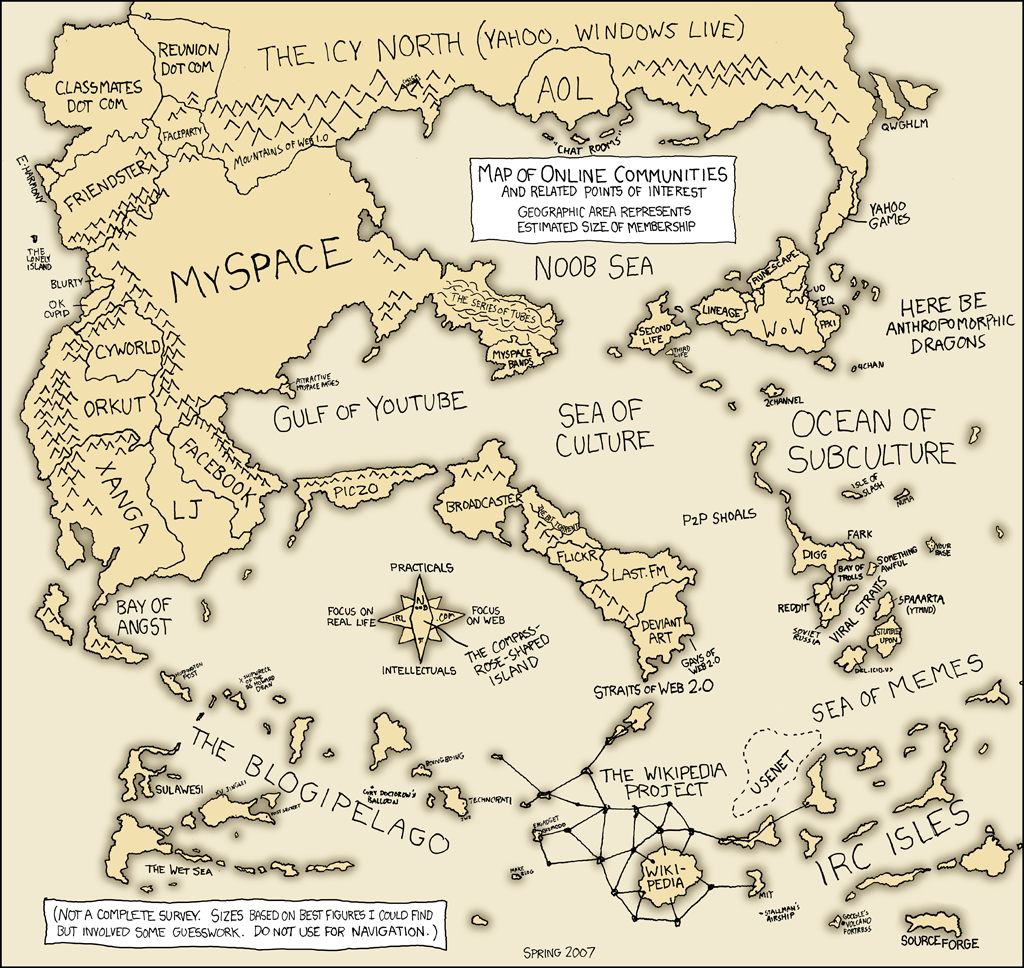
A map of the Social Web


Via media-ocean I found an interesting map of the 'currently known' Social Web (a.k.a. Web 2.0). Here you might take a look at the map in full size. Interesting thing about, the sizes of the single areas (communities) on the map correspond to the approximate number of members. Also the layout has its purpose. On top, you'll find the 'practicals' (Yahoo, Windows Live...), while at the bottom there stick the 'intellectuals' (wikipedia, sourceforge,...). The left is more concerned about 'real life' (I'm missing XING...), while the right is more 'web centered' (second life, antropomorphic dragons, etc...). You can even find good old usenet ...but only as a dashed outline (maybe it is about (or has already) to vanishid and only remembered in old myths like the legendary Atlantis..)
Nice thing to notice, there's also Qwghlm....I can't remember having seen it on any map before :)

Tuesday, May 01, 2007

veni, vidi, emi ... according to Google


Two weeks ago, Google bought Double Click for an incredible amount of money. But for what reason, you might ask....well, to become the dominant internet advertiser. But that is too simple and too short-sighted, as pointed out last week by the German newspaper 'Die Zeit'. According to an article of Götz Hamann, everybody who is worrying about Google to become No. 1 internet advertiser is as short-sighted as this famous Gaulic chief 2000 years ago complaining about Julius Caesar having defeated the entire Gaul. But, Julius Caesar's primary ambition was not only to conquer Gaul, but to become the leader (cesar) of the Roman world empire. And the Google managers .... they also have something else in mind than just becoming the dominant internet advertiser.
They want to preveil their rules in the global advertising market....against the tv networks and also against the newspapers. In relation to the attention that the newspapers get, they receive way too much advertising. This is because of the brokers distributing advertising for the big corporations. These brokers are one of the reasons, why Google is not able to grow as fast as it possibly could. Thus, Google will continue to buy...and who knows, what company will be next....
Alas, and again we will hear: veni, vidi, emi....

(I came, I saw, and I bought..... freely adapted from H.C. aka Gaius Julius Caesar)

Tuesday, April 24, 2007

Marina Lewycka - Die kurze Geschichte des Traktors auf Ukrainisch


Ich bin jetzt schon zwei Bücher im Rückstand, was meine Rezensionen angeht...und bevor ich noch vergesse, was ich zu diesem Buch schreiben wollte, wird es jetzt höchste Zeit....
Wann bin ich zum ersten mal auf das Werk gestoßen? Ich glaube, es war in der S-Bahn (S7) vom Berliner Hauptbahnhof nach Potsdam im vergangenen September. Ich las meine ZEIT und mir fiel dieses Buch mit dem interessanten Cover mit dem "Kartoffeldruck-Traktor" (oder doch eher sozialistisches Propagandaplakat?) auf, das eine Frau mir gegenüber gerade interessiert las. Und dann natürlich der Titel "Kurze Geschichte des Traktors auf Ukrainisch"...Als erstes musste ich an "Eine kurze Geschichte der Zeit" und meine eigene "kurze Geschichte des Internets" (im WWW-Buch) denken, aber der Zweifel, worum es sich bei diesem Buch wohl handeln könnte, lies mir keine Ruhe mehr. Wieder zu Hause in Weimar beim nächsten Besuch der Buchhandlung (ja, auch ich nehme Bücher noch gerne in die Hand, blättere darin und lese an irgendeiner beliebigen Stelle quer....ich brauche einfach dieses 'haptische Erlebnis'...) las ich mir dann den Klappentext durch, der irgendwie alles andere versprach, als ich mir eigentlich vorgestellt hatte....

"Geschichte des Traktors auf Ukrainisch" ist eigentlich Nikolais Projekt, in das er sich flüchtet, als alles den Bach hinunterzugehen droht. Nikolai stammt aus der Ukraine und ist nach dem Krieg mit seiner Familie nach England und in ein besseres Leben ausgewandert. Jetzt ist hat sich der 84-jährige Wittwer in den Kopf gesetzt, eine gut 50 Jahre jüngere blonde ukrainische "Sexbombe" aus ihrem Elend heraus aus der postkommunistischen, von Korruption und Unsicherheit geprägten Ukraine durch Heirat zu "erretten". Klar, dass das seinen beiden Töchtern -- der "Trozkistin" Nadja und ihrem Upper-Class Ggenstück Vera -- nicht gefallen wird. Beide hatten sich über das Erbe der Mutter zerstritten und reden nun schon seit Jahren kein Wort mehr miteinander. "Valentina" heißt der gemeinsame Feind und das personifizierte Übel, das es auszutreiben gilt, ....und Nikolai macht auch noch seine letzten Ersparnisse flüssig, um seinem "Täubchen" noch eine Brustvergrößerung zu spendieren.
Soweit, so gut. Wenn es jetzt immer so weiter ginge, hätte Marina Lewycka nichts weiter geschrieben als eine seichte Einwandererkommödie. Aber in Rückblenden wird immer wieder in ein Blick in die Familiengeschichte Nikolais geworfen und damit auch in die zeitgeschichtliche Ukraine: Stalin und der stalinistische Terror, die von ihm herbeigeführte Hungersnot, mit der er sich die Ukrainer gefügsam machen wollte, der zweite Weltkrieg, die Deutschen....
Zwischendurch aber wird es dann wieder bizarr: Valentinas trashiger "Luxus-Geschmack", Nikolais "Toshiba-Äpfel" (Nein, das ist keine neue wohlschmeckende japanische Apfelsortenzucht, sondern der Name hängt mit dem Hersteller von Nikolais Mikrowelle zusammen...), Nikolais (altersbedingte) Probleme mit seiner körpereigenen "Hydraulik", der Versuch der beiden Schwestern Valentinas Einbürgerung mit allen Mitteln zu unterminieren, der an der Unzulänglichkeit der britischen Behörden scheitert. Am Ende bleibt Nikolai auf alle Fälle seine "Geschichte des Traktors auf Ukrainisch", die ebenfalls mit einigen Skurilitäten aufwarten kann und auf ungeahnte Weise ihren Weg in die Ukraine nimmt....
Insgesamt ein schönes und lesenswertes Buch. Die beschriebenen Situationen geraten mitunter reichlich bizarr (schon wieder...). Die Vorstellungen und Wünsche zweier Einwanderergenerationen könnten unterschiedlicher nicht sein. Um den Kreis wieder zu schließen, für mich ein ideales Buch um die Fahrt in der S-Bahn (S1 Zehlendorf -> S7 Potsdam) etwas kurzweiliger zu gestalten....

Tuesday, April 17, 2007

Summer semester starts at FSU Jena...

Yesterday, the summer semester started and hey....it's really summer! I can't remember any summer semester start with such high temperatures. This semester, I have to give 2 lectures: 'Einführung in die Informatik II' (introduction to computer science II), which takes place mondays and fridays, and 'Informatik der digitalen Medien' (computer science and digital media), also on mondays. The later wil be recorded and will soon be available also for offline participation :)
Intersting thing to mention, this semester I try to maintain a blog for each of the lectures for providing additional information, reading materials, bibliographic notes, etc. You will find the two new blogs at
Of course I will comment on my experiences about managing lectures and courses with a blog.

Friday, April 13, 2007

Tag search vs. keyword search......substitution or complement


As you know, collaborative tagging systems (CTS) have become rather popular Web 2.0 applications (although I don't like the term 'Web 2.0'...please use 'Social Web' instead). A CTS allows each registered user to maintain her own tags that add semantic annotation to corresponding web links. Today, 'tags' are simple unformatted text data. Tags are transporting meaning, i.e. semantics. Because the user is free to choose any text string (symbol) for a certain semantics (concept) related to a given resource (web page or object). To communicate this semantics, two or more users have to agree upon using the same symbols denoting an object (remember the semiotic triangle [1]).

First difficulty is syntax: there are several posibilities to write a word (of course not all of them are necessarely correct or not all of them belong to the same language). The problem becomes even worse, if one tries to combine several words in a single string (how to separate words?...use CamelCase, underscores, blanks, ...).
Next comes language dependent problems such as polysemy (homonyms or synonyms). For homonyms we have the same symbol but different meanings, and for synonyms vice versa.

Syntax and language dependent problems alone cause tag based search to be more difficult to handle than traditional keyword based approaches (by keyword based approach we refer to full text search or keywords assigned to the resource by the resource author or by some designated expert). For full text search, a query string given by the user (or at least its word stem) has to match some string being part of the searched resource. Keywords given to a resource by some designated expert should meet some level of objectivity and thus, a user might be able to 'guess' the keyword while thinking of a well suited query string. Keywords provided by the author refer to her specific point of view (same with tagging). These 'subjective' keywords are much harder to guess for the arbitrary user, because she does not necessarely share the same context with the (tag) author.
In CTS we distinguish several distinct categories of tags [2]. Among others, there are two fundamental different tag categories: descriptive tags and functional tags. Descriptive tags refer to more objective tags, tags that are used to describe a resource in some general maner. Functional tags on the other hand do include an intended functional use esp. for the tag author and thus, are more subjective. While descriptive tags serve better for general web search, functional tags are useful most for their authors, but not for other users.
To analyse the benefit of tagging for web search, we have to take into account that many users are providing tags for a specific resource. Depending on the distribution of the tags attached to a specific resource, one can observe a power law (see also [2]). Few tags are used very often, while most of all the tags attached to a resource do occur only scarcely. Those few tags rather often can be identified with descriptive tags, while the so called 'long tail' of the other tags often belong to the category of functional tags.
So, how can we make use f that fact?
In [3] the authors propose to use tags for search query refinement. For that reason, they distinguish between two defferent categores of tags (that do not necessarely correspondent with descriptive and functional tags). They distinguish search keywords as being the most popular tags assigned to a resource, which can help to increase the hit rate if being used for query refinement, and exploration keywords, which cannot. Because exploration keywords reflect the personalized search context and information need of an individual user they are supposed to be helpful for the exploration process.

Monday, April 09, 2007

Turn your smile on....


Finally, the video clip is there! My friend schminktante as head of makeup department did the groovy 60s style make up in a music video being the diploma thesis of two students from bauhaus university in Weimar.
You may find some backstage information and also some pictures. Anyway....the setting reminds me somehow to the movie 'Catch me if you can'...
So...enjoy and 'turn your smile on'!

Tim Berners-Lee: The Web - Looking Back, Looking Forward


Another talk given by Tim Berners-Lee on 13th March 2007 in London as keynote on the start of this year's prestigious BCS Lovelace lecture. Tim Berners-Lee was granted the Lovelace Medal (named after Ada Lovelace, the daughter of Lord Byron and founder of scientific computing) in 2006. Here is the interview entitled 'Isn't it semantic?' from 2006 with TBL on winning the Lovelace medal. Usually the winner of the Lovelace medal has to give a lecture in the following year, and thus, this years Lovelace lecture is given by Berners-Lee.

The Lovelace Medal is presented to individuals who have made a contribution which is of major significance in the advancement of Information Systems or which adds significantly to the understanding of Information Systems. Among the winners are rather famous computer scientists such as Douglass Engelbart, inventor of the computer mouse and pioneer of GUI, networking, and hypertext systems, who received the medal in 2001, or Linus Torvalds, developer of the LINUX operating system, who received the award in 2000.

(video discovered at Serge Linckels)

Saturday, April 07, 2007

re:publica - Leben im Netz, vom 11. bis 13. April in Berlin


Ich freue mich schon nächste Woche auf das Treffen mit Freunden und Bekannten auf der re:publica in Berlin. Das "Blogger"-Event findet vom 11.-13. April 2007 in der Kalkscheune in Berlin statt und verspricht mit bislang mehr als 300 Anmeldungen und interesanten eingeladenen Vorträgen recht spannend zu werden.
Nicole Simon hat bereits im Vorfeld der re:publica zahlreiche Interviews und Statements mit Teilnehmern und Veranstaltern gesammelt und veröffentlicht diese als PodCast, darunter auch ein Beitrag von Hard Blogging Scientist Jan Schmidt zum Thema Wissenschaftler in der Blogosphäre.
Die Akkreditierung (d.h. der Ticketvorverkauf) hat bereits geschlossen (ich habs mal wieder 'verschwitzt'), aber es gibt noch Tickets an der Tagskasse. Also werde ich am Mittwoch mal vorbeischauen und berichten...
Fast vergessen, die Hard Blogging Scientists richten dort am Freitag, den 13. (ausgerechnet...) um 14.30 Uhr ein Podium/Workshop/Plugin zum Thema 'Wo geht's denn hier in meinen Elfenbeinturm?' aus (also noch ein Tagesticket kaufen...).

Friday, April 06, 2007

Les Gammas sont arrives......


Tatsächlich, sie sind also mitten im Berliner Hauptbahnhof gelandet. Wer? Na die Gammas!
Erinnert sich noch jemand an diesen französischen Sprachkurs 'Les Gammas!', der quasi als Mini-Soap Ende der 70er Jahre mit der Landung dreier Außerirdischer in einer Art Weltraumei (sic!) in Frankreich (also müssen sie wohl auch französisch lernen...) in den dritten Programmen über die deutschen Bildschirme flimmerte...? Verdammt lang her, aber gestern auf dem Nachhauseweg am Berliner Hauptbahnhof fotografiert (laut Presseinformation der deutschen Bahn das größte Osterei der Welt, 8,35m hoch, aus 10.000 Primeln bestehend und noch bis zum 9. April zu bestaunen...)

Tuesday, April 03, 2007

Tim Berners-Lee: The Semantic Web of Data


Tim Berners-Lee is talking about 'The Semantic Web of Data' in a video at Technology Review. In this short presentation the inventor of the world wide web is trying to explain in short, what the Semantic Web is all about, and how it will affect our way to look at data, to understand data, and to work with data (it's all about integration of heterogeneous data...).
('video found at Semantic Bits)

Saturday, March 31, 2007

Vom Wandel der informatischen Bildung - Kolloquium zum 25 jährigen Bestehen der Zeitschrift LOG IN


Am 30.03.07 fand in Jena an der Friedrich-Schiller-Universität ein Kolloquium anläßlich des 25-jährigen Bestehens der Zeitschrift LOG IN statt, zu dem ich eingeladen war. Die Zeitschrift LOG IN beschäftigt sich mit der Informatikausbildung in der Schule und daher stand das Kolloquium unter dem Titel "Vom Wandel der informatischen Bildung".

Aber leider scheinen die Veranstalter selbst noch nicht richtig in unserer heutigen Zeit angekommen zu sein. Warum? Nun, es ist eine Sache, sich darüber zu verbreiten, dass der Informatikausbildung in der Schule zu wenig Raum eingeräumt wird, dass der Lehrplan der allgemein bildenden Schulen Themen in Thüringen wie z.B. 'Die Atmung der Insekten' oder 'Die Ernährung der Hohltiere' durchaus beinhaltet, während andere, heute naheliegende Themen wie 'Wie funktioniert das Internet' oder 'Wie arbeitet ein Computer' nicht darin enthalten sind. Andererseits hätte ich mich natürlich auch über eine Web-Seite zur Veranstaltung, in der die Vortragenden und deren Themen Erwähnung finden, gefreut (bzw. hätte ich dies eigentlich erwartet). Aber weder auf der Web-Seite der Zeitschrift LOG IN (zumindest gibt es eine...) noch auf den Web-Seiten des Veranstalters fand ich hilfreiche Informationen.... (interessanterweise liegt die Einladung zwar auf dem Web-Server, ist aber anscheinend nicht verlinkt....wohl aber im Google-Cache). BTW, das Kolloquium fand im Senatssaal der FSU Jena statt, der neben einem Jugenstilgemälde, das die 9 Musen darstellt (...und von dem es kein Bild weder bei Google noch bei Flickr gibt), auch noch mit einer echte Rodin-Skulptur (Büste der Minerva, Geschenk an die FSU Jena anläßlich der Verleihung der Ehrendoktorwürde an den französischen Bildhauer Auguste Rodin) aufwarten kann.

Natürlich habe ich mich über die Einladung selbst sehr gefreut. Besonders interessant für mich war der Vortrag von Prof. Klaus Brunnstein (Präsident der IFIP) über die "frühen Jahre der Schulinformatik" (1972-1982), in dem er auch über die Zeit der Einführung von Informatik als Studienfach an deutschen Hochschulen referierte (natürlich einschließlich interessanter Annekdoten). Zentral war natürlich auch die Frage danach, welchen Zweck die Informatikausbildung in der Schule dienen solle. Immer wieder kamen die Referenten dabei auf die 'informatische Grundbildung' zu sprechen. Alleine die Schüler in die Lage zu versetzen, die Technik zu nutzen ist nicht ausreichend. Vielmehr geht es darum, ein Verständnis von der Funktionsweise der Technik zu entwickeln, um deren Verhalten auch in Extrem- und Gefahrsituationen richtig einschätzen zu können, d.h. neben der Fähigkeit der Nutzung stehen Fragen der 'Beherrschbarkeit', der Risikoabschätzung und möglichst auch der Grenzen der Technik.
Auch der folgende Vortrag, ausgerichtet von den beiden Herren der LOG IN Redaktion (Bernhard Koerber und Ingo-Rüdiger Peters) war sehr unterhaltsam, da Einblicke in die Entstehungs- und Entwicklungsgeschichte der Zeitschrift gewährt wurden, die jetzt über 25 Jahre lang ehrenamtlich (!) von den beiden herausgegeben wird.
Am Nachmittag berichteten Dr. Wolfgang Pohl über die Geschichte des Bundeswettbewerbs Informatik und Prof. Steffen Friedrich über die Königsteiner Gespräche (zu denen ich leider auch keine Web-Seite finden konnte...).

Abgerundet wurde die Veranstaltung durch eine Podiumsdiskussion zum Thema "Welche Bildung braucht die Informationsgesellschaft", in denen Prof. Winkler (FSU Jena) auch den eingangs zitierten Vergleich des aktuellen thüringer Lehrplans auf den Plan brachte. Interessant auch sein Rückgriff auf die Geschichte der Einführung der naturwissenschaftlichen Fächer in den Schulunterricht. Erst gegen Ende des 19. Jahrhunderts fanden Fächer wie Physik und Chemie tatsächlich Einzug in die Curricula der Gymnasien. Aber nicht durch eine entsprechende Erweiterung des damals humanistischen Fächerkanons, sondern durch die Neugründung der mathematisch-naturwissenschaftlichen Gymnasien....
Um also der Informatischen Bildung Raum im Lehrplan der allgemeinbildenden Schulen zu verschaffen, bedarf es weniger einer Evolution als vielmehr einer Revolution....

Wednesday, March 28, 2007

The State of the Semantic Web


In the DERI blog I have found a rather interesting presentation from Ivan Herman, (W3C) Semantic Web Activity Leader, about the current state of the semantic web, given at the International Conference on Semantic Web & Digital Libraries in Bangalore, India.

He also gives some insight in what has been achieved concerning language standardization (RDF, OWL, SPARQL, etc.), already existing vocabularies, current implementations and available knowledge databases (ontologies).

Besides all the achievments of the recent years, Ivan also points out where the deficiencies are:

  • how to bind to different communities (e.g., the “digital library world”)

  • how (and where from) to get RDF data

  • several stil missing functionalitiessuch as rules, “light” ontologies, fuzzy reasoning, necessity to review RDF and OWL,…

  • different misconceptions, existing messaging problems

  • and of course the need for more applications, more deployment, and also acceptance


To get more working applications the porting of alreay existing knowledge resources (as already existing classification schemes, lexicons, htesauri, etc.) into the context of the semantic web is mandatory. SKOS (Simple Knowledge Organization System) is one of the W3C activities that has exactely this purpose. SKOS is built on top of RDF and serves as a formal language for representing structured well defined vocabularies.

Tuesday, March 27, 2007

Online Umfrage zum IT Gipfel 2006 ....


Mein lieber Kollege Justus Bross möchte eine online Umfrage bzgl. der Einrichtung eines Blog zum IT Gipfel der Bundesregierung (hier auch ein Video-Podcast zum Thema) im vergangenen Jahr vornehmen. Ziel ist dabei die Einrichtung eines 'Gipfelblogs', das -- da unter der Flagge der Bundesregierung -- spezielle Vorkehrungen in Sachen Moderation und redaktionelle Kontrolle beinhalten soll (und über die wir derzeit noch diskutieren).

Daher also hier der Aufruf, sich kurz 10 Minuten Zeit zu nehmen und schnell über den Fragebogen zu gehen. Ihr würdet uns damit sehr helfen.

Hier der Link zum online-Fragebogen
....und für eine Weiterverbreitung wären wir natürlich ebenso sehr dankbar.

...und so geht unser Dank bereits an

ACHTUNG: Besten Dank an alle Teilnehmer und Teilnhmerinnen!!
Wir haben knapp 200 ausgefüllte Fragebögen zurückerhalten und die Aktion beendet.
Sobald die Auswertung abgeschlossen ist, werden wir eine erste Bilanz ziehen.

From iRack to iRan.....

I guess apple never thought (but maybe dreamed) of extending their iProduct line into domestic appliances or even sports ... :)


Link: sevenload.com

Monday, March 26, 2007

Alexandre Dumas - Die drei Musketiere (The three Musketeers)


For sure you will think 'hey, why is he reading that old children's book again?', but no, you're wrong. I've read this masterpiece of Alexandre Dumas for the very first time. Of course, everybody knows the story. We all have seen so many movies and remakes of movies, and the musketeers have become a cliché even long ago. But, I had the chance to get a rather old copy. It's an almost 100 years old german translation (of course in old german typesetting). And one thing about the book is, it's language is remarkable and so different compared to today's german. But before I'll go into details, let me rather briefely recapitulate the story (in german....):

Wir schreiben das Jahr 1625. D'Artagnan, der arme Sohn eines Landadeligen aus der Gascogne will sein Glück als Musketier in der Garde des Herrn von Treville - also der Leibgarde des Königs Ludwig XIII. - versuchen. Ausgestattet mit einem Empfehlungsschreiben seines Vaters, einem altgedienten Musketier gerät er, der sich wie alle Gasconier (so Dumas) leicht in seiner Ehre gekränkt sieht, in eine Auseinandersetzung mit einem mysteriösen Gardisten des Kardinals Richelieu. Bevor es aber zu einem Duell kommt, wird er vom Küchenpersonal der Landschenke, in der er Rast macht, niedergeschlagen und seines Empfehlungsschreibens beraubt.
In Paris angekommen versucht er sich dennoch um eine Audienz bei Herrn von Treville und verstrickt sich im Laufe des Tages - natürlich bedingt durch sein aufbrausendes Temperament ebenso wie durch seine eigene Tollpatschigkeit - in sage und schreibe drei Duelle mit drei Musketieren des Königs, namentlich mit den drei Freunden Athos, Aramis und Portos. Verabredet im Park von Saint Germaine werden alle vier überrascht von einer Patrouille des Kardinals. D'Artagnan bietet den drei Freunden seine Hilfe beim bevorstehenden Degengefecht an, aus dem die Musketiere siegreich hervorgehen.....und das ist der Beginn einer Reihe äußerst spannend zu lesender Abenteuer.....
Die eigentliche Handlung ist ja aus diversen Filmen bekannt, allerding ist die Charakterzeichnung Dumas sprachlich natürlich noch wesentlich reizvoller als deren filmische Umsetzung. Für mich wird wohl immer die Verfilmung aus den 70er Jahren mit Michael York als D'Artagnan, Oliver Reed als Athos und Richard Chamberlain als Aramis (wer den Portos gespielt hat fällt mir nicht ein....war aber jemand, den ich sonst nicht weiter kannte) DIE VERFILMUNG überhaupt bleiben. Besonders schön - neben einem beeindruckenden Oliver Reed und unberechenbaren Charlton Heston als Kardinal Richelieu - war wohl die Tatsache, dass sich anscheinend keine der Romanfiguren (außer den Bösewichtern) in dieser Verfilmung wirklich ernst nimmt. Ach und natürlich Racquel Welch als wohlgefomte und unwiderstehliche Constanze, Geraldine Chaplin als porzellanfarbene, zerbrechliche Königin und Faye Dunaway als durchtrieben böse verführerische Mylady deWinter. Der Film (d.h. die Verfilmung des kompletten Romans) kam damals ja in zwei Teilen in die Kinos und es braucht seine Zeit, die über 700 Seiten des Romans in Szene zu setzen. Ach, fast hätte ich den Erzbösewicht Rouchford vergessen, den Mann mit der Narbe, hinter dem D'Artagnan den ganzen Roman über her ist. Der wird in besagter Verfilmung von Christopher Lee (unser aller 60er/70er Jahre Dracula) gespielt.
Daneben gabe es zahlreiche weitere Verfilmungen an die ich mich erinnern kann. Angefangen von einer UFA Verfilmung aus den 30er Jahren über einen ersten Farbfilm mit Gene Kelly in der Hauptrolle [to be continued.....] und dann natürlich auch noch diverse Verfilmungen aus den 80er Jahren. Die letzte bemerkenswerte Verfilmung des Musketierstoffes betrifft einen späteren Roman Dumas, nämlich 'Den Mann mit der eisernen Maske' (auch unter dem Titel '10 Jahre danach' oder 'Der Vicomte von Bragelonne' erschienen), der vorallem mit seiner Besetzungsliste der bereits etwas gealterten Haudegen brillierte (Gerard Depardieu, Jeremy Irons, John Malkovich....).

Mein Fazit: Der Roman hat es in sich! Kein Wunder, das er sich über 150 Jahre internationaler Beliebtheit erfreuen kann. Natürlich darf man keine allzu tiefgründigen Charakterstudien und innere Monologe erwarten, aber Dumas gelingt es, seine Figuren nicht nur in haarsträubend flott erzählte Abenteuer zu verwickeln, sondern ihnen auch noch ziemlich viel Persönlichkeit mit auf den Weg zu geben. Besonders deutlich wird das an der unberechenbaren Gestalt der Lady deWinter und D'artagnans ambiguen Gefühlsaufwallungen ihr gegenüber. So liebt er sie auf der einen Seite (oder ist zumindest immens verliebt..) wie er sie auf der anderen Seite als Geschöpf des Kardinals zutiefst hasst.
Also, LESEN! und am besten nicht die aktuellen Übersetzungen, sondern eine ältere (vor 1930), um sich an der mitunter barocken Sprachgewalt zu erfreuen.......

Saturday, March 24, 2007

A short note on Semantic Search Engines


Lars featured an article on Hakia, a 'semantic search engine' in his blog today.
Contrarywise to Google, Hakia uses natural language processing (NLP) to 'understand' search queries given in natural language (and not as plain keywords). Ok, this is now new.
Just remember AskJeeves, a.k.a. Ask.com. But, in difference to that search engine, Hakia claims to perform a 'semantic search' (and not a keyword based search). If you read a little bit further in their technical description at Hakia labs you will find thet they are using a parser called 'OntoSem', which as they claim is able to perform a 'deep semantic analysis' of sentences. This parser is used for query string analysis and also for the generation of the search index. But, their search index is different to that we are used from 'traditional' search engines.
Just remember, traditional keyword based search engines extract so called 'descriptors' from web pages that are used to describe the content of those pages. These descriptors are managed within an inverted index. Thus, by accessing the inverted index with a descriptor (=keyword in query string), a list of web pages will be returned together with some weights indicating the relevance of the descriptor for the page.
So, how does the index work in Hakia? They clain, that their parser is analyzing all web pages to be indexed sentence by sentence. In effect, all possible questions that can be posed for each sentence are generated, forming what they call the 'QDEX data'. All possible questions for all sentences in all pages have to be stored in an index-like data structure (simply for fast and efficient access). If now a query string contains a question, this question is mapped against the index, resulting in a large number of 'relevant' (questions, sentences and in the end...) web pages. Now they apply a 'smart' algorithm called 'Semantic Rank' which orders the resulting list of documents according to their relevance wrt. the question given in the query string. More details about the technique is not published (at least not to my knowledge).

Thus, the only way to find out about the quality of their approach is to try out their search engine. A nice feature is that they have included small example applications where you may try out OntoSem or QDEX interactively by yourself. I have only tried OntoSem (because for QDEX you have to sign up a request) and the result was not really different from any standard NLP-Parser (and thus not really convincing. I will sign up and give QDEX a try..and of course I will post the result).

If I compare their approach to Google's, the problem is that Google is also claiming to incorporate semantic technology altogether. So, again I can only compare the results of my queries. I have tried several queries and have come to the following results:

  • in general the results from hakia do look very promising!

  • in comparison to Google results, they are not really that different this may come because of my 'queries' and thus, my results are probably not really objective).
    Let me give you an example: I was asking both (Google and Hakia) the question 'When did the Semantic Web start?'. Ok, it's not so easy to understand at all. First, it didn't really start (as an being implementation), but the topic itself startet several years ago...and so I was curious about the results:

Ok, as stated before, this is not representative at all, but I will keep an eye on Hakia anyway. As soon as I have more representative experiences (and hopefully some comments or other interesting comparisons), I will write about.

One thing in the end. After all, what I have read about Hakia and on their web site, they seem to have a completely different notion of 'Semantic Search'. What they do is to apply (enhanced) information retrieval techniques based on natural language processing. They do NOT evaluate any additional given semantic annotation (RDF, OWL, etc...), which might be addid into the web pages or connected to them. They claim (same as Peter Norwig) that the average user is much too stupid to supply semantic annotation (because for doing that he needs to be a linguist as they say).
Of course, if you are following the PLAIN trail of the W3C and encode everything by hand (HTML, XML, RDF, OWL, SWRL, etc...) then you have to be some real expert. But today, you (at least most of you) don't encode HTML by your own. Remember, there are lots of real nice WYSIWYG editors for doing that AND (even more) there are several simplifications (just think of writing your blog). In the same way there will be smart user interfaces and editors providing help in generating semantic annotations for your texts. First and most simple step is providing labels and keywords (just 'tags') for your blog posts. Most people do that...just because (1) they want to put some order into the set of their postings and (2) they want their posting to be found.

Friday, March 23, 2007

Who's afraid of Google...?


Today I read an article in the German newspaper 'DIE ZEIT' entitled with 'Who's afraid of Google'. It was about Google's project of digitizing the entire printed books of the world and their deal with the 'Bayerische Staatsbibliothek' (the 2nd largest scientific library in Germany). Several scientists and librarians were asked about what they think about Google's plans and its effects on the culture in general.
In general the opinion was more critical than enthusiastic (and I can follow their arguments). On the one hand, Google offers some kind of democratozation of the reading culture (meaning that in the end all books might be available for everybody at any time). But, Google as a philanthropist...? Business first! This means, clicks are money...and thus, it's all about money. The main criticism of the community was that Google will get a monopoly concerning all our reading. Thus, the obvious next step (from some pessimistic point of view) is censorship (or at least 'filtering'). Just imagine Google to be in a position that dictates what we are reading (I mean concerning the content). Then, there is no democracy at all....
The other complaint of the librarians was concerning the poor quality of Google scanning the books. There are examples of 'thumbs' inside scans (btw I was not able to find an image proof of that...but I confess that I was searching with Google...) and the offered resolution of 300 dpi for color/grayscale (for handwritten codices as e.g. the 'Sachsenspiegel' this is not enough) and 600 dpi for print is also subject of criticism.

Speaking as a scientist, I'm really happy that almost all scientific literature (at least for me as being a computer scientist) is available in the world wide web and that it can be accessed by searching Google. I don't want to stay in libraries for hours, discussing with librarians, filling out forms, copying articles from books, and maybe waiting weeks or months before I am able to access certain literature. But...(and now be honest)...who of you does not print out an article for reading (and commenting, annotating, etc...).
Google print maybe will offer the possibility to read the very first edition of 'Robinson Crusoe' while sunbathing at the beach...but will you? For sure, we all LOVE books. But, do we also 'love' a computer screen? You might touch books, feel (and scent) the old leather of a binding, browsing through worn pages, making annotations and remarks....just having the ability to put content (knowledge) into some matter (the book), take it everywhere you want to, being your companion...and you know where it is (on the shelf, on your nightstand, in the bathroom...). Do you think, having a book just on some screen is something similar (concerning your sensation). You switch the screen off...and the book is gone. Of course, it's somewhere in the digital universe...but not for real on your nightstand when you put out the light.....

In the end, I don't think that Google print will be as 'mean' as being projected by many librarians. Of course it will bring some change (and also some positive change). But it will not 'extinguish' the book. Publishers and booksellers will keep on selling books and we will also keep on reading them. Monopolies are not democratic (...some contradiction ahead). Therefore, we should also support all the other digitizing projects, as e.g. the digitizing project of the 'Börsenverein des deutsche Buchhandels' or the 'European Library' and their 'Europeana' project that will be launched by the end of march.

Thursday, March 22, 2007

The Semantic Web will NOT fail .....


...well, maybe it will not develop as projected by the W3C...but there is something evolving :)
Just to answer the question raised at the DERI blog "The Semantic Web will fail?" and to make a statement to Stephen Downes' post on "Why the Semantic Web will fail".
First thing, I wonder why the DERI blog leaves Downes' statement uncommented. Isn't DERI doing a lot of Semantic Web research? Ok, but let's go into detail. Downes' first thesis is

"The Semantic Web will never work because it depends on businesses working together, on them cooperating."

Does it? Why do inter business relations work...? Although there's competition going on, the benefit of sharing common standards is pretty obvious. Maybe you're right that the Semantic Web will not develop as the W3C projects (just remember ISO/OSI and TCP/IP for the sake of standardization). Maybe it's not possible to design the Semantic Web in a top-down manner. But, on the other hand maybe we will see some bottom-up evolution as in the way of the social web (aka web 2.0). And why not thinking of some hybrid aproach? Then, business will adapt sooner or later...and they will. At least, when they face the situation that semantic technology is required to run money making applications. Maybe we are still lightyears away from what is promised by the Semantic Web, but from my point of view we are just about to see some major changes and developments in the upcoming 5-10 years.

Further he says that
"But the big problem is they believed everyone would work together:
- would agree on web standards (hah!)
- would adopt a common vocabulary (you don't say)
- would reliably expose their APIs so anyone could use them (as if)
"

The point is that one of the main purposes of the Semantic Web is to get together heterogeneous data. That means data that are coded with different vocabularies (but containing some additional encoded semantic that states how one vocabulary relates to the terms of another). And just look at RDF. There are already a lot of companies that suport RDF in their applications.

Anyway, the criticism is not new. Just remember Peter Norwig's argument...The nice thing about Stephen Downes' post is the discussion below that is definitely worth while reading...

Tuesday, March 20, 2007

Liquid Browsing - a new paradigm for accessing huge collections of data ?!


As promissed yesterday, I've installed iverse's liquidfile, a kind of substitute (or supplement) for the mac finder. (For all those mac illiterates: the finder is some kind of file system browser). Liquidfile applies the principle of liquid browsing to the filesystem of your computer. To get a short overview, how liquid browsing works, just take a look at the following short movie presentations [1] [2]. It's rather difficult to describe the way how it works with words, because its a visual way of browsing...and thus it is better explained in a visual way also. It's a 2 dimensional visualization, where e.g. the x-axis represents a timeline (as e.g. file creation date) and the y-axis represents all files in an alphabetical order. Then, every file is put on that grid and denoted with a bubble. The size of the bubble (which itself is semi-transparent) reflects the size of the file. The nice thing in general about liquid browsing is that you are able to visualize huge amount of data also on small displays. In that case the mouse pointer acts as some kind of magnifying glass.

As for the file system on your computer, this kind of visualizations has some advantages. First, you can dissolve the entire directory structure (if you want) and look at all files at once (on my computer this were more than 15.000 files). You have the possibility to combine complex (realtime) filtering with several selection mechanisms to find the files you are looking for. Simultaneously, the order in which the files are presented in general stays always the same and does not change. Thus, your visual memory will always be able to memorize the approximate position of a distinct file that you are looking for.
Of course the system has several drawbacks (at least now). My macBook is rather new (january 2007). Thus, almost all of my files have the same creation date (most of them were simply copied to the macBook on the very same day....). Therefore, the time axis will work best, if you start to work with your computer and they will be created/changed over the time.
Another drawback is the limitation of the axes to represent only filenames, filesizes, or creation/change dates. I would like to order files also according to other (also content based) criterias to get a better overview.

But, it's a nice appetizer anyway. What I would like to try out is to visualize relationships between entities (files/documents) with this technique. Just imagine bubbles of different entities and if I focus on one, all other bubbles that represent entities, which are in a certain relationship to the entity being in focus will highlight or move closer (of course in realtime...).

Monday, March 19, 2007

CeBIT Day 3 ... finally


Finally I'm back home at the HPI in Potsdam. Yesterday (Sunday) was my last day at this year's CeBIT computer fair and there were a lot of interesting things going on...
First, by chance I met HBS-fellow Jan Schmidt. Together with Oliver Gassner and Reinhard Karger as host he was talking about the use of networking platforms such as second life, their use, the hype, and social spam (read more about it in Jan's blog).
Another very interesting talk was scheduled afterwards: Carsten Waldeck, founder of iverse was talking about liquidfile - a file browsing application based on liquid browsing. Liquid browsing offers the possibility to arrange and manage a huge number of data items (e.g. documents) in a rather efficient way by a smart 2d-visualization. This principle is now applied to file system management on your local computer. There is an implementation for the mac and I will test it asap to give you a report.
In addition Carsten Waldek and host Reinhard Karger were talking about the plan of installing a social networking platform for archiving intellectual content (not in the sense of intelectual property). But, you should be able to express an idea, to upload your idea in any form of document, and to receive an official timestamp. Of course maintaining a database of 'ideas' will be rather difficult. Thus, all those ideas have to be translated into 'logic' (means with the help of ontology and rule representation languages). Then, if you have a new idea, you can check, if anyone else has already thought about it and if there are some people with similar interest. The other way around, you will be able justify that you have a claim in some idea because you have registered it previously. The trouble is....translate a natural language document into logic representation...you know that this - if done completely automatically - will fail (at least too often....). Thus, we will have to wait, until the semantic web will come.
On the other hand....we have been thinking and thinking again about possible killer applications for the semantic web. This(!) could be one....

BTW, I also met another HBS-fellow Andreas Scheper after the talk (read more about the CeBIT future talks and see some videos in Andreas sein Blog). We decided to meet again at re:publica in berlin, where als the HBS has a so called plugin that will be filled with some fruitful discussion...

So, CeBIT is over for me now... If you want to stay informed about ongoing CeBIT work and CeBIT after hours, keep on reading Miss Marple's Blog.

It's CeBIT time again ... Day 2


Incredible, but true...yesterday evening we've succeeded in walking through ALL CeBIT halls. If you've ever been there, you know that this means something. Somebody told us, that taking the whole 9 yards means walking almost 10 kilometers. Ok, in the evening without the crowded passages its much easier (except the crowded parties of course). And there the CeBIT often offers Live music of exceptional quality.

But before that you stand there at your booth from 9 am to 6 pm, talking to peoples, explaining and demonstrating your project, making new contacts, taking and planning appointments...
Saturday and Sunday are the days of the so called 'Beutelratten' (meaning non-business visitors that are hunting all possible giveaways and gadgets, gathering all in free giveaway bags that they have to carry around everywhere and everytime). But, anyway besides of those, today we also had some rather interesting business visitors.
Tomorrow on Sunday will be my last CeBIT day...and I must say it's okay. Another three days would be really too stressful...

Please don't forget to register at OSOTIS, our new video search engine, and win an iPod!!
(to be continued...)

Saturday, March 17, 2007

It's CeBIT time again ... Day 1

Friday, my first day on CeBIT computer fair. This year, we (Osotis) have a booth at the joint exhibition of 'Mitteldeutschland' in hall 09 - the hall of research and future. Next to us are the other EXIST-SEED funded projects of the FSU Jena -- MobiSoft (watch out for Steffen's Blog, esp. for his pictures) and Navimatrix. On the other hand - my second employer is also present in hall 09 - the Hasso-Plattner-Institute of the University of Potsdam at the joint exhibition of 'Berlin-Brandenburg' with the projects Lock-Keeper (a hardware firewalling system), TeleTask (a simple tele lecturing system), and Tele Lab (a laboratory for security techniques). I will write about the most interesting projects of hall 09 in the upcoming posts.

Yesterday, we had a lot of trouble to keep our system running. But today, Jörg (fortunately) managed to solve the major problems. Thus, I tried to upload a few more videos (including a lot of Berkeley public lectures). If you read this blog, please register at Osotis, because we need a lot of users to keep the system working!

As usual, CeBIT would be half as interesting without it's after business parties. Almost in each of the more than 20 halls there were several parties going on (many including live music, all including free drinks, some including free food...). It's the most difficult task during the day to find out, where and what is going on after business, where to go for 'dinner', for some drinks, and for to listening the best music.

Thursday, March 15, 2007

OSOTIS ...winning an iPod...and the CeBIT rumble starts again


I have already talked about the video search engine OSOTIS, but it has again improved over the time. First at all, what does 'OSOTIS' mean? No, it's not some sort of ancient egyptian god. It's just derived from the botanical name for 'forget-me-not', which is greek 'Myosotis'. So, the name already gives some hint for the offered service:
(1) OSOTIS offers search within videos
(2) right now, most videos available at OSOTIS are academic lecture recordings, ranging from short viseo sequences from the famous Solvay conference in 1927 (where Einstein replied to Bohr that God does not throw dice...) up to lectures from Berkeley, MIT, Stanford, Oxford, or also my lectures at the Friedrich-Schiller-University in Jena (Germany).
(3) OSOTIS does not host the videos (as youTube or Google does). They only provide links to your resources. Nevertheless, OSOTIS downloads the offered video stream for post processing and for generating timed annotations for the video serch.
(4) You can register at OSOTIS (btw if you register before April 15th you have the chance to win an iPod 30GB) and maintain your own video collections, maintain an own user profile, make friends, choose your favourite videos, and (!) you can tag videos.
(5) You can even tag inside video streams. This means that the tagging information also includes time information and that the search is able to replay the video exactly from the right position.
(6) OSOTIS is a social networking tool.
And OSOTIS is at the CeBIT computer fair that has just opened its gates. Visit us at hall 9, D04!
Yes...and tomorrow I will be at CeBIT in Hannover for the next three days. So just stay tuned, because I will write about everything interesting that comes into my way.

Wednesday, March 14, 2007

exams...it's always (most times) the same

Again, today are oral examinations to do. During the semester break, it's the time for most of the exams for the computer science diplomas, masters, or bachelors. I teach several courses that are relevant for students of computer science, as 'web technologies' or 'technical foundations of the internet (TFI)' (and of course 'semantic web')...
Most students come to get examines in 'webtechnologies' or 'TFI', and because these courses are given for senior students, we do oral examinations because there are to few students to justify the labour of preparing a written exam.
But, the point is...most student simply think that web technology or internet technology is something they know already (maybe because it's part of our everyday life) and they don't prepare well or they prepare in the wrong way. I always tell them 'you don't have to give me technical details and parameters. Think global! You have to understand HOW everything is working together. Don't take things granted..ASK if you don't understand or if you cannot answer WHY things are done the way they were...'
It's almost useless. Often I have the feeling that I could talk to the wall instead of human beings capable of listening and understanding. Of course, the facts are quite simple. Everybody has heard of HTTP. Everybody knows that HTTP is used for transporting messages between browser and WWW-server...but, if it comes to (web)-caching, cache control, and stuff like that..and that it is even related to HTTP...I guess most people take that for granted and forget it immediately after having heard.
The same with web-programming. Of course everybody has heard of distributed programming, stubs, skeleton, and so on. But, if you ask, what exactely a stub has to do, to get a procedure call transfered to another computer....
I could tell you hundreds of examples including search engine technology, semantic web, ontologies, web-caching, dynamic HTML, client-side/server-side programming, ...

Sometimes, I'm a little bit frustrated. The students even have the possibility to watch the lectures again from our video database. They even have the possibility to get them all on DVD to watch them again at home. In addition we prepare a lot of material....and what is the outcome? About 2/3 (two thirds) of all exams are dissapointing. Don't get me wrong. Not all of these students do fail the exam. They were prepared an knew quite something...but if you try to figure out how things interact and why certain things are arranged in the way they are....you realize that the students take those things for granted and don't care to take a look behind..

O.k....enough of blustering around. The next exam will be at 3 p.m. Let's hope that sombody is reading this blog :)

Wednesday, March 07, 2007

Daniel Kehlmann - Die Vermessung der Welt


I have no idea whether this book has been already translated in English. If so, read it! (...it has. I've just looked it up at amazon..the title is Measuring the World)
It's some kind of biography of two of the most outstanding people of the 19th century, Carl Friedrich Gauss and Alexander von Humboldt. But beware...it's some very special kind of biography......(By the way, I've visited the 'Alexander-von-Humboldt Gymnasium in Schweinfurt' and made my Abitur there).
I'll switch to German.
Das Buch war für mich wirklich eine der großen Überraschungen in den Neuerscheinungen des letzten Jahres. Der Gattungsbegriff Biografie trifft es nicht ganz, aber irgendwie natürlich doch. Wir stürzen mitten in die Geschichte, als der bereits betagte Gauss nach Berlin aufbrechen muss, um auf Einladung von Humboldt an einem Kongress teilzunehmen. Eigentlich will er ja gar nicht, vorallem nicht aus dem Bett heraus, aus seinem Haus, aus Göttingen...und überhaupt. Köstlich...vor allem auch der Dialog (eigentlich eher ein Monolog) mit Eugen, seinem seiner Ansicht nach 'missratenem' Sohn. Dazu hat er keine Papiere - die man zur damaligen Zeit für die Reise von Göttingen nach Berlin durchaus benötigte - erzählt dem Polizeibeamten, dass Napoleon seinerzeit sogar auf eine Kanonade Göttingens nur seinetwegen verzichtet hätte...dazu muss sich der Leser die damaligen Verhältnisse in "Deutschland" vor Augen führen. Die herrschenden Fürsten hatten eine Heidenangst vor revolutionären "demokratischen" Umtrieben...und auf Napoleon war man in Deutschland nach dem Wiener Kongress in kaum einem der dazu zählenden 100+x Kleinstaaten allzu gut zu sprechen. Naja...der Polizist muss einen verdächtigen "Turner" (Jawoll....gedenke man doch auch dem "Turnvater" Jahn) verfolgen und beide Gauss gelangen schließlich wohlbehalten nach Berlin, wo sie schon von einem umtriebigen Alexander von Humboldt in Empfang genommen werden. Sehr schön auch die Schilderung, wie man mit Hilfe der noch nicht so recht ausgereiften Erfindung des Herren Daguerre versucht "die Zeit festzuhalten"....
Nun...in diesem Stil wird uns schließlich das Leben der beiden ungleichen Geistesgrößen und Sonderlingen geschildert. Während Gauss sich an die Entdeckung der Mathematik (und schließlich auch der Physik) macht und eine 'innere Welt' bis an ihre Grenzen erforscht, begibt sich Humboldt auf Entdeckungsreise nach Süd- und Mittelamerika, die 'äußere Welt' bis zu ihren Grenzen zu erforschen.
Am Ende bemerken die beiden mittlerweile schon ergrauten Herren, dass sie doch gar nicht so verschieden sind - auch wenn ihr Leben kaum unterschiedlicher hätte sein können.

Ich hab das Buch sehr genossen. Vor allem natürlich, da ich mich durch die geschilderten Eigenarten der beiden Protagonisten an den ein oder anderen hochbegabten (aber doch recht schrulligen) Zeitgenossen erinnert gefühlt habe, der meinen Weg bislang gekreuzt hat...natürlich entdeckt man auch die ein oder andere eigene 'Seltsamkeit' wieder. Ein weiteres Highlight ist für mich Kehlmanns Sprachgewalt. Nein, das Werk ist nichts für den "Wald-und-Wiesen-Gelegenheits-JerryCotton-Leser". Ganz im Gegenteil. Natürlich wirkt die Sprache (ich sage nur "lang lebe der Konjunktiv"!) etwas antiquiert, aber wir befinden uns ja schließlich in der ersten Hälfte des 19. Jahrhunderts und nicht bei RTL.
Fazit: Ich hab schon lange nicht mehr ein so kurzweiliges und interessantes Buch gelesen. Lesebefehl!

Sunday, March 04, 2007

Ning and Library 2.0


Again, it was only a matter of time, until a Web 2.0 Site turns up that allows you to create your own social networking web site. Ning hosts numerous socual networking web sites covering all possible issues. It's rather simple...just register and create your own site following the dialog.
Yesterday - again by chance...i.e. by tag-browsing bibsonomy entries - I found one of Ning's social networking sites on the topic 'library 2.0'. I signed up and I'm rather curious what will happen there :)